



What Is Anomaly Detection in Cybersecurity?
Anomaly detection in cybersecurity is the process of identifying activity that differs meaningfully from an established baseline of normal behavior. A security system can monitor users, endpoints, applications, networks, cloud services, IoT devices, and industrial equipment, then flag unusual changes that may indicate compromised credentials, malware, lateral movement, data exfiltration, policy violations, misconfiguration, or operational failure.
Unlike signature based detection, which looks for known malicious patterns, anomaly based detection can surface behavior that has not been seen before. That makes it useful for detecting novel and rapidly changing threats. An anomaly, however, is not proof of an attack. Effective systems add context, correlate related events, and give analysts enough evidence to decide whether a deviation is malicious, benign, or caused by a change in normal operations.
In This Guide
- What cybersecurity anomaly detection means and how it works
- How anomaly based detection differs from signatures rules and intrusion detection
- The main types of network endpoint identity cloud IoT and OT anomalies
- How artificial intelligence and machine learning support threat detection
- Common anomaly detection examples benefits limitations and false positive risks
- Best practices for building a useful real time detection program
What Is Cybersecurity Anomaly Detection
Cybersecurity anomaly detection compares current activity with an expected pattern and assigns significance to the difference. The expected pattern may be a statistical range, a historical baseline, a peer group, a sequence of events, an approved configuration, or a machine learning model of normal behavior. The system then generates an alert or investigation signal when the deviation crosses a defined threshold or appears suspicious in context.
The monitored behavior can include login time and location, process execution, file access, privilege changes, network flows, device communications, API calls, data transfer volume, protocol use, resource consumption, configuration changes, sensor readings, and control commands. MicroAI’s Security and Monitoring agent applies environment specific intelligence across industrial equipment, networks, applications, and critical infrastructure so teams can detect suspicious behavior and investigate it closer to the source.
Security anomaly detection is related to outlier detection and behavioral analytics, but the security objective is narrower: determine whether an unusual event could represent risk. A rare event can be legitimate, while a malicious action can sometimes resemble normal work. The detector therefore needs operating context, asset criticality, identity information, and related events rather than relying on rarity alone.
How Anomaly Detection Works in Cybersecurity
Anomaly detection tools vary, but a practical cybersecurity workflow usually follows seven stages.
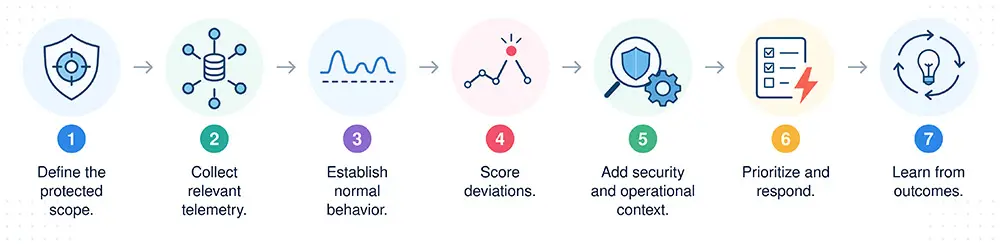
- Define the protected scope.
Identify the users, endpoints, network segments, applications, cloud resources, IoT devices, or OT assets that matter and the security decisions the system must support. - Collect relevant telemetry.
Use logs, network flows, authentication events, process activity, device signals, configuration history, application traces, and operational context that can reveal a change in behavior. - Establish normal behavior.
Build baselines for each asset, identity, peer group, operating mode, time window, or workload. A factory machine during startup may have a different normal pattern than the same machine during steady production. - Score deviations.
Apply statistics, thresholds, rules, machine learning, or a combination of methods to measure how far current behavior differs from the expected pattern. - Add security and operational context.
Consider asset importance, user role, maintenance windows, recent changes, known vulnerabilities, threat intelligence, and the sequence of surrounding events. - Prioritize and respond.
Send high value findings into an analyst workflow, incident system, containment process, or approved automated action. The response should match the confidence level and potential impact. - Learn from outcomes.
Use analyst decisions, confirmed incidents, operating changes, and false positives to update thresholds, features, baselines, and response rules.
The result should be more than an alert that says something is unusual. A useful finding explains what changed, how far it moved from normal, which systems or users are affected, what happened before and after the change, and what the security or operations team should inspect next.
Anomaly Detection Versus Signature Based Detection
Signature based tools compare activity with known indicators or attack patterns. Anomaly based tools compare activity with expected behavior. Rules and thresholds enforce known policies, while hybrid systems combine all three approaches. These methods are complementary rather than interchangeable.
| Detection method | What it looks for | Primary strength | Main limitation |
|---|---|---|---|
| Signature based detection | Known malicious patterns, indicators, hashes, rules, or attack signatures | Precise detection of recognized threats when signatures are current | May miss new, modified, or previously unseen behavior |
| Rules and thresholds | Activity that violates a defined policy or exceeds a fixed limit | Clear logic that is easy to audit and apply to known conditions | Static rules can be noisy or fail to reflect changing operating conditions |
| Anomaly based detection | Deviations from a statistical, behavioral, or machine specific baseline | Can surface unknown or subtle activity without a known signature | Unusual activity is not always malicious and may produce false positives |
| Hybrid detection | Known indicators, policy violations, behavioral deviations, and related context | Balances coverage of known threats with visibility into new behavior | Requires data integration, tuning, and a defined investigation workflow |
Signature detection is often efficient and precise for recognized threats, but it depends on prior knowledge. Behavioral anomaly detection can identify suspicious changes associated with unknown threats, compromised accounts, and modified attack techniques, but it can also flag legitimate activity. Strong security programs use known indicators for certainty and anomaly detection for broader behavioral coverage.
Types of Anomaly Detection in Cybersecurity
Network Anomaly Detection
Network anomaly detection monitors traffic patterns, flows, protocols, connections, destinations, bandwidth use, packet behavior, and communication paths. It can surface beaconing, unexpected east west traffic, unusual data transfer, new external destinations, protocol misuse, lateral movement, or changes that may precede service degradation. Network behavior analytics and network detection and response tools often use this approach. MicroAI’s Network Quality of Service solution connects performance and connectivity signals with operating context across critical networks.
User and Entity Behavior Analytics
User and entity behavior analytics, commonly called UEBA, establishes expected patterns for people, accounts, service identities, devices, and applications. It may flag impossible travel, access at an unusual time, a new device, abnormal privilege use, rare data access, or an account behaving differently from similar users. UEBA is especially useful when an attacker uses valid credentials and the login itself does not match a known malicious signature.
Endpoint and Host Anomaly Detection
Endpoint anomaly detection evaluates processes, services, files, memory activity, system calls, resource use, removable media, configuration changes, and outbound connections on workstations, servers, gateways, and embedded devices. Examples include an approved application spawning an unusual child process, a new service starting after a privilege change, or a device communicating with a destination it has never used before.
Application API and Cloud Anomaly Detection
Application and API anomaly detection looks for changes in request volume, error rates, authentication failures, data access, dependencies, response patterns, and administrative actions. Cloud anomaly detection adds control plane events, identity and access changes, new resources, storage access, workload behavior, and geographic or device context. These signals help teams connect security risk with application and infrastructure behavior.
IoT and OT Anomaly Detection
IoT and operational technology anomaly detection monitors connected devices, controllers, industrial protocols, machine states, sensor relationships, firmware or configuration changes, and command sequences. A device may be suspicious if it communicates outside its expected peer group, uses a new protocol, receives a control command at an unusual stage of production, or behaves differently from comparable equipment. See these examples of IoT systems for a broader view of connected devices and the data they generate.
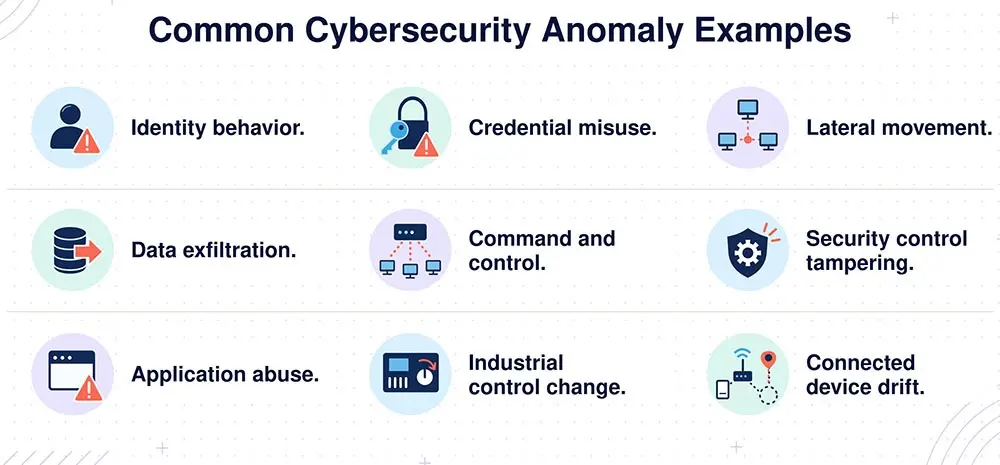
Common Cybersecurity Anomaly Examples
- Identity behavior. A normally local account signs in from a new country, changes authentication settings, and accesses systems outside its usual role.
- Credential misuse. A service account begins interactive login activity or accesses a larger set of resources than its established pattern.
- Lateral movement. One endpoint starts making repeated connections to internal systems and administrative ports it has not previously contacted.
- Data exfiltration. A user or device transfers an unusual volume of data to a new destination or at an unexpected time.
- Command and control. A host creates small periodic outbound connections whose timing and destination differ from its normal communications.
- Security control tampering. Logging stops, a monitoring service is disabled, or a firewall rule changes shortly after privilege escalation.
- Application abuse. An API key makes a burst of requests against records or functions that the associated application rarely uses.
- Industrial control change. A controller receives an unusual write command, setpoint adjustment, firmware change, or communication from an unapproved engineering workstation.
- Connected device drift. An IoT device changes its traffic volume, protocol, destination, update behavior, or peer relationships without an approved operational reason.
Each event becomes more meaningful when correlated with surrounding evidence. A late night login may be harmless on its own. The same login followed by privilege elevation, a new external connection, and a large data transfer deserves immediate investigation.
How Artificial Intelligence Supports Anomaly Detection
Artificial intelligence helps security teams model complex behavior across more signals than fixed rules can reasonably cover. For a foundation in the terminology, see this primer on artificial intelligence and machine learning. Cybersecurity anomaly detection can use several analytical methods.
- Statistical models. Measure deviation from historical ranges, distributions, seasonality, rates, or expected relationships among variables.
- Unsupervised learning. Groups similar behavior and identifies outliers without requiring every event to be labeled as benign or malicious.
- Supervised learning. Learns from labeled examples of known benign and malicious activity when representative training data is available.
- Semi supervised learning. Learns a model of normal behavior from mostly trusted data and flags activity that does not fit that model.
- Time series analysis. Detects changes in sequence, timing, trend, seasonality, and relationships among network, application, device, or sensor signals.
- Graph and sequence analysis. Examines relationships among users, devices, processes, connections, and events to detect suspicious paths or multistage activity.
Generative AI and AI agents can support the investigation layer by summarizing evidence, retrieving relevant procedures, comparing similar incidents, and explaining why an alert was prioritized. They should not turn a low confidence deviation into a definitive claim. The detector, evidence, response authority, and human review points should remain clear.
Real Time and Edge Anomaly Detection
Real time anomaly detection evaluates activity as it occurs or with minimal delay. This matters when a suspicious process, network connection, control command, or account action could spread quickly. The required response time depends on the asset, threat, safety implications, and available containment options.
Edge anomaly detection processes selected signals on or near the device, machine, server, gateway, or network element that creates the data. Local analysis can reduce latency, bandwidth use, and dependence on continuous cloud connectivity while keeping sensitive operational data closer to its source. When hardware resources are constrained, lightweight AI can make focused models more practical at the edge.
MicroAI AtomML places machine learning on embedded devices, while AtomML+ supports intelligence across groups of IT and OT assets. A hybrid design can use local models for time sensitive detection and a central platform for cross asset correlation, long term learning, investigation, and policy management.

Anomaly Detection for Industrial and OT Security
Industrial anomaly detection must account for more than network traffic. Production state, maintenance activity, operator actions, safety constraints, machine mode, quality conditions, and physical process relationships can determine whether a deviation is expected or risky. A pump startup, recipe change, planned firmware update, or line changeover may look unusual without this context.
OT environments also contain long lived equipment, proprietary protocols, limited computing resources, segmented networks, intermittent connectivity, and systems that cannot be interrupted for aggressive scanning. Passive monitoring, asset specific baselines, edge processing, controlled response, and close coordination between security and operations teams are especially important.
A broader asset observability approach helps connect security changes with health, performance, configuration, and operational context. MicroAI also provides guidance on endpoint asset observability and zero trust network security for teams protecting distributed infrastructure.
Benefits of Cybersecurity Anomaly Detection
- Visibility into suspicious behavior that does not match a known signature
- Earlier identification of compromised accounts lateral movement and unusual data access
- Continuous monitoring across large numbers of users devices applications and network connections
- Environment specific detection that reflects how each asset or peer group normally behaves
- Better prioritization when anomalies are correlated with asset criticality and related events
- Local detection for remote low connectivity or time sensitive operational environments
- Additional context for incident investigation root cause analysis and response planning
Teams can also combine individual findings into cybersecurity health scores that summarize security posture across machines, processes, and networks. The underlying evidence should remain available so a score does not hide which events or conditions require attention.
Challenges and Limitations
- False positives. Legitimate but uncommon behavior can appear suspicious, especially when baselines lack operating context.
- False negatives. An attacker may imitate normal behavior, move slowly, or stay within thresholds. No model detects every threat.
- Changing normal behavior. New software, staffing, production schedules, business cycles, maintenance, and network changes can make an old baseline inaccurate.
- Cold start. A new asset or account may not have enough trusted history to establish a reliable baseline.
- Incomplete telemetry. Missing logs, blind network segments, encrypted traffic, clock errors, and inconsistent identifiers can weaken correlation.
- Model and data quality. Biased samples, contaminated training periods, weak features, or poorly chosen thresholds can create misleading results.
- Explainability. Analysts need to understand why an event was scored as unusual and which evidence supports the conclusion.
- Operational risk. Automatic containment can interrupt production or critical services if confidence, authorization, and safety controls are not defined.
- Privacy and governance. Behavior monitoring can involve sensitive employee, customer, device, or operational data and requires appropriate access and retention controls.
How to Reduce False Positives
- Baseline by context.
Model each asset, role, peer group, time window, workload, and operating mode instead of forcing one definition of normal across the entire environment. - Use multiple signals.
Prioritize a deviation when it is supported by identity, endpoint, network, application, configuration, or operational evidence. - Account for approved changes.
Feed maintenance windows, deployments, shift schedules, travel, commissioning, and configuration changes into the detection process. - Tune thresholds by consequence.
Use stricter escalation criteria for noisy low risk events and faster review for deviations involving critical assets or privileged identities. - Preserve explanations.
Show the baseline, deviation, related events, affected assets, and reasons for prioritization so analysts can validate the finding. - Capture analyst feedback.
Record confirmed incidents, benign changes, duplicate alerts, and missed detections, then use those outcomes to improve the model and workflow. - Measure detection quality.
Track precision, recall, false positive rate, alert volume, investigation time, time to containment, and the percentage of findings that lead to useful action.
Best Practices for a Cybersecurity Anomaly Detection Program
- Start with a specific threat scenario asset group and response decision rather than collecting every available signal
- Combine anomaly detection with signatures rules threat intelligence vulnerability data and zero trust controls
- Separate unusual behavior from confirmed malicious behavior in alerts reports and automated actions
- Protect the telemetry models baselines and response workflows from tampering
- Test detectors against realistic normal changes and attack scenarios before enabling automated containment
- Define ownership across security IT operations engineering and incident response teams
- Review baselines and model performance when the environment process or threat profile changes
- Keep a human approval step for actions that could affect safety availability production or critical services
Organizations moving from reactive alerts toward earlier risk identification can explore MicroAI’s approach to predictive cybersecurity. Teams that need to evaluate models against their own data can use AIStudio to develop, tune, and assess models for defined security and operational use cases.
Cybersecurity Intelligence at the Edge
MicroAI brings intelligence to the industrial equipment, networks, and critical infrastructure teams depend on, helping them operate more efficiently and resolve problems faster. Its edge native security capabilities learn environment specific behavior, identify suspicious changes, connect related evidence, and help teams determine where an issue began and what may be affected.
Anomaly detection is most useful when it leads to a clear investigation or response. MicroAI’s cybersecurity solution connects continuous monitoring, localized analysis, threat detection, and operational context across IT and OT assets.
Start with one device, one set of signals, and one security question. Prompt one device for free to see how an AI agent can help investigate operational and security behavior using the context your team already has.
Frequently Asked Questions About IoT
What Is Anomaly Detection in Cybersecurity in Simple Terms?
Cybersecurity anomaly detection finds activity that is meaningfully different from normal behavior. It can monitor users, devices, endpoints, applications, networks, cloud services, IoT systems, and industrial equipment. The deviation becomes a security signal that should be evaluated with context and related evidence.
What Is the Difference Between Anomaly Detection and Intrusion Detection?
Intrusion detection is the broader goal of identifying malicious or unauthorized activity. Anomaly detection is one method an intrusion detection system can use. An IDS may combine anomaly based analysis with signatures, rules, reputation data, protocol checks, and other detection methods.
Can Anomaly Detection Identify Zero Day Attacks?
It can identify unusual behavior associated with a previously unknown attack even when no signature exists, but it cannot guarantee detection of every zero day exploit. An attacker may behave within expected patterns, and legitimate activity may also look unusual. Correlation, investigation, and layered controls remain necessary.
What Data Is Used for Cybersecurity Anomaly Detection?
Common inputs include authentication events, network flows, DNS activity, endpoint processes, file and registry changes, application logs, API calls, cloud control plane events, configuration history, threat intelligence, IoT telemetry, industrial protocol activity, sensor data, and operational context.
Is Machine Learning Required for Anomaly Detection?
No. Anomaly detection can use statistical ranges, thresholds, rules, peer comparisons, and expert defined logic. Machine learning becomes useful when normal behavior involves many variables, changes over time, or differs across users and assets. Many production systems combine several methods.
Why Does Anomaly Detection Produce False Positives?
Unusual does not always mean malicious. Travel, maintenance, software releases, production changes, new equipment, seasonal workloads, and legitimate administrative work can all differ from the baseline. Context aware baselines, event correlation, tuned thresholds, and analyst feedback help reduce false positives.
How Is Anomaly Detection Used in OT Security?
OT anomaly detection monitors industrial communications, device relationships, controller activity, machine states, sensor patterns, configurations, and control commands. It can flag behavior that differs from an asset’s approved operating mode, but findings must be interpreted with production, maintenance, safety, and process context before action is taken.
Does Anomaly Detection Replace Signature Based Security?
No. Signatures remain valuable for known threats and high confidence indicators. Anomaly detection adds visibility into unknown, modified, or environment specific behavior. A layered program combines signatures, rules, behavioral models, asset context, threat intelligence, and a tested response process.