

What Is IoT? 30+ of the Best Internet of Things Examples, Devices and Use Cases in 2026
What is the Internet of Things?
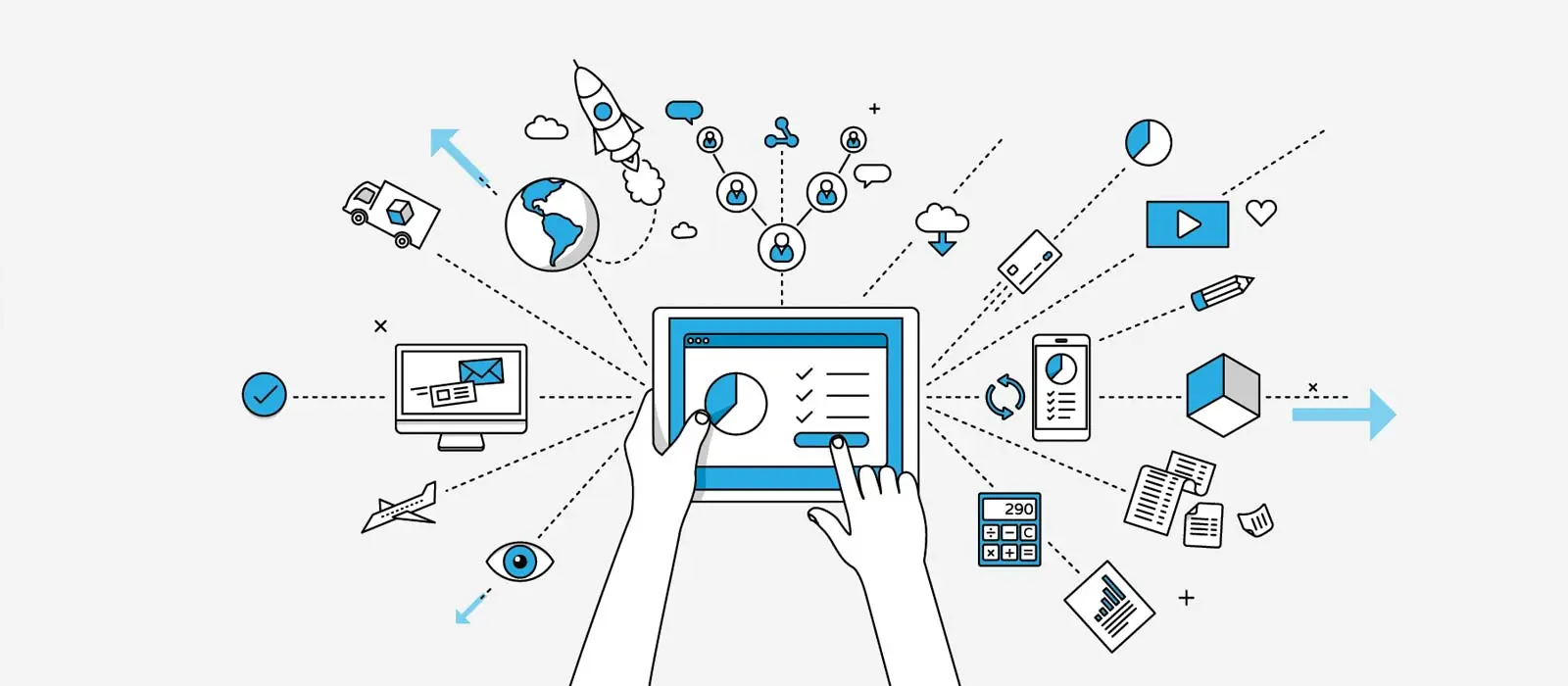
The Internet of Things, or IoT, is a network of physical devices, machines, sensors, vehicles, appliances, infrastructure, and other connected assets that collect and exchange data.
An IoT system connects the physical world with software. Sensors observe what is happening, networks move that information, computing systems analyze it, and applications help people or automated systems decide what to do next.
Some of the most familiar IoT examples are smart thermostats, fitness trackers, connected cars, security cameras, and smart appliances. In industrial environments, IoT includes connected factory machines, PLCs, robots, pumps, network equipment, power systems, data center infrastructure, and other operational assets.
The biggest change in IoT today is what happens after a device becomes connected.
Connectivity alone creates data. Combining IoT with edge computing, machine learning, and industrial AI can turn that data into fault detection, predictive maintenance, operational intelligence, and automated action.
That is where platforms such as MicroAI Industrial AI Agents are extending traditional IoT into intelligent physical operations.
What are some examples of IoT?
IoT devices now appear across homes, factories, vehicles, telecommunications networks, data centers, utilities, healthcare, agriculture, logistics, buildings, and cities.
Common examples include:
| IoT example | Industry | Typical data |
|---|---|---|
| Smart thermostat | Smart home | Temperature, occupancy |
| Fitness trackerm | Consumer | Heart rate, activity |
| Smart meter | Utilities | Energy consumption |
| Connected car | Automotive | Location, diagnostics |
| Security camera | Security | Video, motion |
| Industrial robot | Manufacturing | Position, load, cycles |
| CNC machine | Manufacturing | Vibration, temperature |
| Injection molding machine | Manufacturing | Pressure, cycle time |
| Compressor | Industrial | Pressure, vibration |
| Pump | Industrial | Flow, vibration |
| Smart conveyor | Manufacturing | Speed, load |
| Vision camera | Manufacturing | Images, defects |
| PLC | Industrial automation | Process signals |
| IoT gateway | Industrial IoT | Device telemetry |
| Cellular modem | Telecom | Signal, latency |
| 5G device | Telecom | Connectivity, QoS |
| Network router | Networking | Traffic, packet loss |
| Server | Data center | CPU, memory, temperature |
| Cooling unit | Data center | Temperature, airflow |
| UPS system | Data center | Power, battery |
| Smart transformer | Utilities | Load, temperature |
| Grid sensor | Utilities | Voltage, frequency |
| Fleet vehicle | Logistics | Location, engine data |
| Warehouse sensor | Logistics | Inventory, environment |
| Agricultural sensor | Agriculture | Moisture, temperature |
| Connected medical device | Healthcare | Device measurements |
| Smart lighting | Buildings | Power, occupancy |
| HVAC controller | Buildings | Temperature, airflow |
| Smart parking sensor | Cities | Occupancy |
| Environmental sensor | Infrastructure | Air, water, weather |
Connected manufacturing equipment is one of the most important categories of IoT because these systems can directly affect production, quality, downtime, energy use, and operational costs.
How does IoT work?
Most Internet of Things systems contain five basic layers.
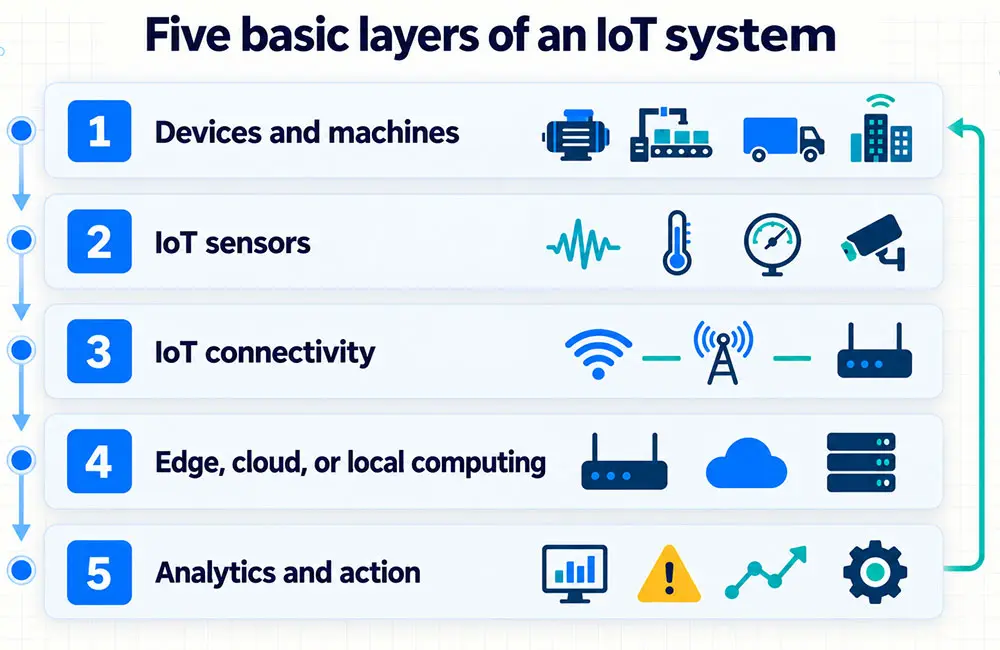
1. Devices and machines
The physical asset generates information.
This could be a thermostat in a home, a vibration sensor on an industrial motor, a cellular device on a telecom network, or an injection molding machine inside a factory.
2. IoT sensors
Sensors measure conditions in the physical world.
Common IoT sensors measure:
- Temperature
- Vibration
- Pressure
- Humidity
- Position
- Speed
- Flow
- Current
- Voltage
- Sound
- Light
- Motion
- Proximity
- Air quality
- Images and video
Industrial IoT devices may combine several sensor inputs to create a more complete understanding of how equipment is operating.
3. IoT connectivity
The device must communicate with other devices, gateways, platforms, or applications.
Common IoT connectivity technologies include:
- Ethernet
- Wi-Fi
- Bluetooth
- 5G
- LTE
- LTE-M
- NB-IoT
- LoRaWAN
- Zigbee
- Cellular networks
- Private industrial networks
The appropriate technology depends on bandwidth, distance, latency, reliability, power requirements, and the environment in which the device operates.
4. Edge, cloud, or local computing
The data must be processed somewhere.
Traditional IoT architectures often transmit large volumes of device data to centralized cloud environments.
Edge IoT moves more intelligence closer to the device.
This can reduce network dependency, decrease unnecessary data movement, and enable systems to react more quickly when operating conditions change.
MicroAI’s Asset Observability solution moves operational intelligence closer to IT and OT assets, while MicroAI Machine Intelligence applies machine-specific intelligence to industrial equipment.
5. Analytics and action
Collecting IoT data is only useful if something happens with it.
IoT analytics can help teams answer questions such as:
- Is this machine healthy?
- Why is production slowing down?
- Which device is experiencing a fault?
- Is network quality declining?
- When will equipment require maintenance?
- Why is energy consumption increasing?
- Which service is affected?
- What should the operator inspect next?
MicroAI Data Analytics and Management combines operational data with analytics and visualization across manufacturing, telecom, automotive, infrastructure, and other connected environments.
What is an IoT device?
An IoT device is a physical object with sensing, computing, or communication capabilities that allow it to exchange information with other systems.
A device does not need to be a consumer gadget.
Industrial equipment can become an IoT device when machine controllers, sensors, gateways, or embedded processors expose operating information to connected systems.
Examples include:
- Consumer IoT: smart watches, speakers, thermostats, appliances, cameras.
- Enterprise IoT: building systems, access controls, environmental monitors, connected office equipment.
- Industrial IoT: machines, robots, PLCs, motors, pumps, compressors, production lines, inspection equipment.
- Infrastructure IoT: traffic systems, utility equipment, smart meters, power equipment, transportation assets.
- Telecom IoT: cellular modules, gateways, routers, connected endpoints, and network equipment.
What is an IoT sensor?
An IoT sensor converts a physical condition into data that a connected system can analyze.
For example, a vibration sensor attached to an industrial motor can continuously measure mechanical behavior.
Looking at the vibration value alone provides monitoring.
Combining vibration with temperature, electrical load, operating history, maintenance records, and other machine signals can provide much deeper intelligence.
This is an important distinction in modern IoT.
The value is no longer simply collecting more sensor data. The value is understanding how multiple signals relate to the condition of the real asset.
What is an IoT gateway?
An IoT gateway connects devices or machines with other computing and network systems.
The gateway may:
- Collect information from several devices
- Translate protocols
- Filter data
- Perform local processing
- Apply security controls
- Send selected information to cloud systems
- Receive commands
- Run edge applications or AI models
As IoT deployments become larger, gateways increasingly serve as local intelligence points rather than simple data-transfer devices.
MicroAI Launchpad supports the management, visualization, and operational use of information from machines, sensors, connected devices, networks, and other assets.
What is an IoT platform?
An IoT platform is the software layer that connects, manages, analyzes, and helps organizations act on information from connected assets.
A modern IoT platform may provide:
- Device connectivity
- Device management
- Data ingestion
- Edge processing
- Analytics
- Dashboards
- Fault detection
- Alerts
- Security
- Workflow automation
- AI and machine learning
- APIs and integrations
- Fleet or asset management
Earlier generations of IoT platforms focused heavily on getting data from devices into dashboards.
Modern platforms increasingly need to help users understand what the data means and what should happen next.
MicroAI Launchpad provides an operational environment for connected assets, while AIStudio supports AI model development and operational data analysis.
What is Industrial IoT or IIoT?
The Industrial Internet of Things, or IIoT, applies IoT technology to machines, equipment, production systems, energy assets, infrastructure, transportation systems, and other industrial environments.
Industrial IoT typically has different requirements from consumer IoT.
Reliability matters more. Downtime can stop production. Security can affect physical operations. Equipment may remain in service for decades. Networks may be constrained. Decisions may need to happen immediately.
That makes IIoT especially relevant to:
- Manufacturing
- Telecom
- Data centers
- Energy
- Utilities
- Automotive
- Infrastructure
- Defense
- Logistics
MicroAI’s Manufacturing AI solutions connect machines, PLCs, sensors, applications, and operational systems to support predictive and increasingly agentic manufacturing workflows.
What are the most important IoT use cases in manufacturing?
Manufacturing is one of the clearest examples of IoT moving from connectivity to operational intelligence.
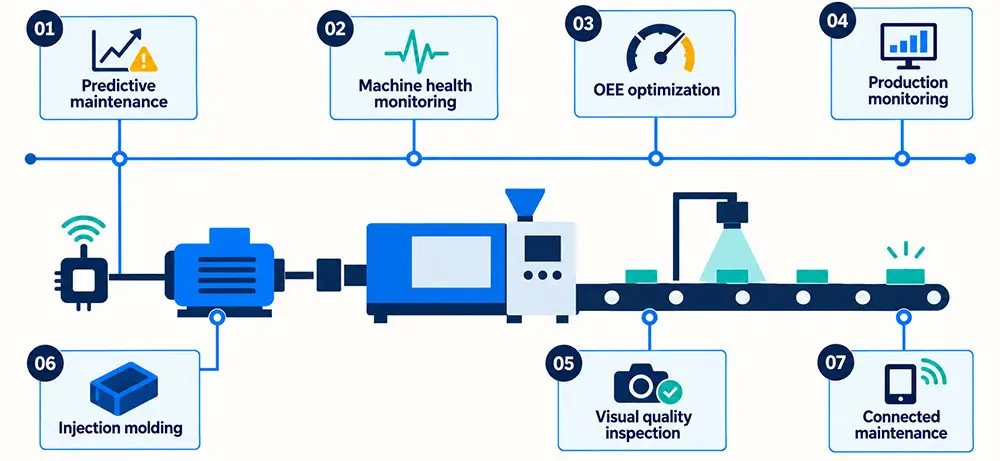
Predictive maintenance
IoT sensors collect information such as vibration, temperature, pressure, current, cycle time, and equipment status.
Instead of waiting for a machine to fail, AI can analyze those signals for changes that indicate developing equipment problems.
MicroAI’s Predictive Manufacturing solution combines connected equipment data with edge intelligence to help manufacturers move from reactive operations toward predictive manufacturing.
Machine health monitoring
Connected machines can continuously communicate information about their condition.
MicroAI Machine Intelligence learns how individual equipment behaves under real operating conditions and helps teams identify changes in health, performance, quality, and risk.
OEE optimization
IoT data can help manufacturers understand availability, performance, and quality losses.
Instead of looking only at a final OEE number, connected machine intelligence can help determine why that number changed.
Production monitoring
IoT systems can track machine status, throughput, cycle time, downtime, production counts, and operating conditions across lines and facilities.
MicroAI’s Factory Management System connects production performance, equipment health, fault detection, maintenance, quality, and factory-level operational information.
Visual quality inspection
Connected cameras can become IoT sensors.
Computer vision can inspect products, detect defects, verify assembly, monitor production, and provide visual information to other factory systems.
MicroAI Vision brings AI-enabled visual intelligence to industrial and edge environments.
Injection molding
An injection molding machine can generate data related to cycle time, pressure, temperature, screw recovery, cushion position, energy, alarms, and quality.
Combining these IoT signals can help operations teams understand process drift, machine health, downtime, and quality problems.
Connected maintenance
IoT information can also connect with maintenance records, technical documentation, work orders, and historical equipment behavior.
This gives technicians more context before they begin troubleshooting.
How is IoT used in telecommunications?
Telecommunications networks depend on enormous ecosystems of connected devices.
IoT creates both an opportunity and a challenge for network operators.
As the number and variety of connected endpoints grows, operators need to understand:
- Device health
- Connectivity
- Signal quality
- Latency
- Jitter
- Packet loss
- Throughput
- Service quality
- Customer impact
- Network faults
MicroAI Network Quality of Service turns telemetry from devices, services, applications, and infrastructure into network intelligence that helps teams understand service health, detect faults, identify likely root causes, and respond faster.
MicroAI’s broader Telecom AI solutions are designed for operators, CSPs, OEMs, and connected-device environments.
How is IoT used in data centers?
Data centers contain thousands of connected systems that generate operational data.
Examples of data center IoT include:
- Server health monitoring
- Rack temperature sensors
- Humidity sensors
- Power distribution monitoring
- UPS monitoring
- Cooling-system sensors
- Airflow monitoring
- Leak detection
- Access controls
- Network equipment
- Energy meters
- Environmental monitoring
The next stage is connecting facility IoT with application and server intelligence.
A rise in application latency may ultimately relate to infrastructure, server load, networking, or environmental conditions.
MicroAI Data Center Intelligence is designed around this operational relationship, while MicroAI Application Performance Monitoring connects application health, dependencies, infrastructure signals, faults, and user impact.
How is IoT used in infrastructure and smart systems?
IoT allows physical infrastructure to become observable.
Connected infrastructure can include:
- Roads
- Bridges
- Rail systems
- Buildings
- Water systems
- Traffic infrastructure
- Energy systems
- Public transportation
- Environmental monitoring systems
- Smart-city equipment
Sensors provide the real-time information. AI can then help determine what that information means.
MicroAI’s Infrastructure Intelligence solutions combine connected asset information, sensors, fault detection, predictive maintenance, and operational intelligence for infrastructure environments.
How is IoT used in automotive systems?
Modern vehicles are networks of connected electronic systems.
Automotive IoT applications include:
- Vehicle telematics
- Fleet tracking
- Remote diagnostics
- Predictive maintenance
- Vehicle connectivity
- Over-the-air updates
- Connected infotainment
- Battery monitoring
- Charging infrastructure
- V2X communications
- Vehicle cybersecurity
- Connected manufacturing
MicroAI Automotive Intelligence applies edge AI, predictive insights, connectivity intelligence, and cybersecurity to connected vehicle environments.
What are other real-world IoT applications?
- Smart homes: Thermostats, security cameras, doorbells, lighting, appliances, voice assistants, leak sensors, and energy-management systems.
- Healthcare: Connected medical equipment, remote patient-monitoring devices, medication systems, wearables, and hospital asset tracking.
- Agriculture: Soil sensors, irrigation systems, livestock monitoring, weather stations, connected tractors, and crop-monitoring equipment.
- Logistics: Fleet telematics, GPS trackers, cold-chain sensors, warehouse equipment, container tracking, and inventory-monitoring systems.
- Retail: Smart shelves, inventory sensors, digital signage, refrigeration monitoring, connected checkout systems, and customer-traffic sensors.
- Buildings: HVAC controls, access systems, lighting, occupancy sensors, elevators, energy meters, fire systems, and environmental monitoring.
- Energy and utilities: Smart meters, grid sensors, transformers, substations, renewable-energy equipment, batteries, field assets, and power-management systems.
What is AIoT?
AIoT means Artificial Intelligence of Things.
It combines IoT connectivity and sensor data with artificial intelligence.
Traditional IoT answers:
What is happening?
AIoT can help answer:
Why is it happening?
What is likely to happen next?
What should we do?
This shift is particularly important in industrial environments.
A connected motor can report vibration.
An intelligent motor-monitoring system can determine whether that vibration represents a developing fault, compare it with historical behavior, and help maintenance teams determine what to inspect.
A connected network device can report packet loss.
An intelligent network agent can determine which services are affected and what is likely causing the degradation.
A connected production machine can report cycle time.
An intelligent manufacturing agent can determine why the cycle changed and how it affects output.
This is also the foundation of industrial AI agents for physical operations.
What is edge IoT?
Edge IoT means processing some IoT data close to the device or physical environment rather than transmitting everything to a distant cloud.
Edge computing can be useful when:
- Fast response matters
- Connectivity is unreliable
- Devices generate large amounts of data
- Operational information is sensitive
- Cloud transmission is expensive
- Local operation must continue during an outage
MicroAI uses edge and embedded intelligence to bring machine learning closer to connected assets.
This creates an architecture where intelligence can exist at several levels:
Device → Edge → Operational Platform → Cloud
The correct architecture does not always mean choosing edge instead of cloud.
Many effective IoT systems use both.
What is IoT asset observability?
IoT monitoring tells you the value of a signal.
IoT asset observability helps you understand the condition and behavior of the asset producing that signal.
For example:
A temperature reading of 175°F is data.
Knowing whether 175°F is normal for this exact machine, under this exact load and operating condition, is context.
Knowing that temperature, vibration, and motor load changed together before the last failure is intelligence.
MicroAI’s Asset Observability solution is built around moving from simple connected-device monitoring toward deeper IT and OT asset intelligence.
How is IoT used for cybersecurity?
Every connected device expands the digital environment that organizations must protect.
IoT security can involve:
- Device identity
- Authentication
- Encryption
- Network segmentation
- Access control
- Firmware security
- Secure updates
- Network monitoring
- Device behavior monitoring
- Fault and threat detection
- Incident response
Security becomes especially important when IoT devices interact with machines, production equipment, vehicles, utilities, or infrastructure.
A compromised consumer device is inconvenient.
A compromised industrial IoT device may affect a physical process.
MicroAI Security and Monitoring applies edge-based behavioral intelligence to connected devices, networks, machines, and operational systems.
MicroAI also provides a broader Cyber Security solution for connected IT and OT environments.
What are the benefits of IoT?
The business value of IoT depends on what organizations do with the data.
Important benefits can include:
- Real-time visibility
- Remote monitoring
- Faster fault detection
- Predictive maintenance
- Higher equipment availability
- Improved production efficiency
- Reduced downtime
- Better asset utilization
- Improved quality
- Lower energy consumption
- Improved customer experience
- Better network performance
- Automated workflows
- Improved safety
- More informed decisions
What are the biggest IoT challenges?
IoT becomes more difficult as organizations move from a few connected devices to thousands or millions of endpoints.
- Too much data: Connected equipment can generate enormous volumes of information, much of which may have little operational value.
- Disconnected systems: Machine data, maintenance information, applications, network monitoring, documentation, and business systems frequently exist in separate platforms.
- Cybersecurity: Every endpoint, gateway, application, and network connection can create another potential security concern.
- Legacy equipment: Industrial organizations often operate valuable machines that were built long before modern IoT platforms existed.
- Network dependency: Cloud-dependent IoT architectures may struggle when connectivity becomes slow, expensive, or unreliable.
- Lack of context: A system may detect a fault without explaining why it happened, what is affected, or what the team should do.
- Scaling: A successful five-device pilot does not automatically become a successful deployment across thousands of devices.
How do you choose an IoT platform?
A good IoT platform should match the actual operational problem rather than simply collect as much data as possible.
Organizations should evaluate whether the platform can:
- Connect existing devices and machines
- Support relevant communication protocols
- Ingest real-time data
- Operate at the edge when needed
- Scale across devices and facilities
- Detect equipment and network faults
- Analyze historical and live information
- Integrate with existing systems
- Secure connected assets
- Visualize operational conditions
- Support APIs
- Automate workflows
- Apply AI and machine learning
- Explain results clearly
- Convert insights into action
For industrial environments, it is also important to ask whether the platform understands the asset itself, not just the sensor feeding it.
IoT is evolving from connected devices to intelligent operations
The first phase of IoT was about connectivity.
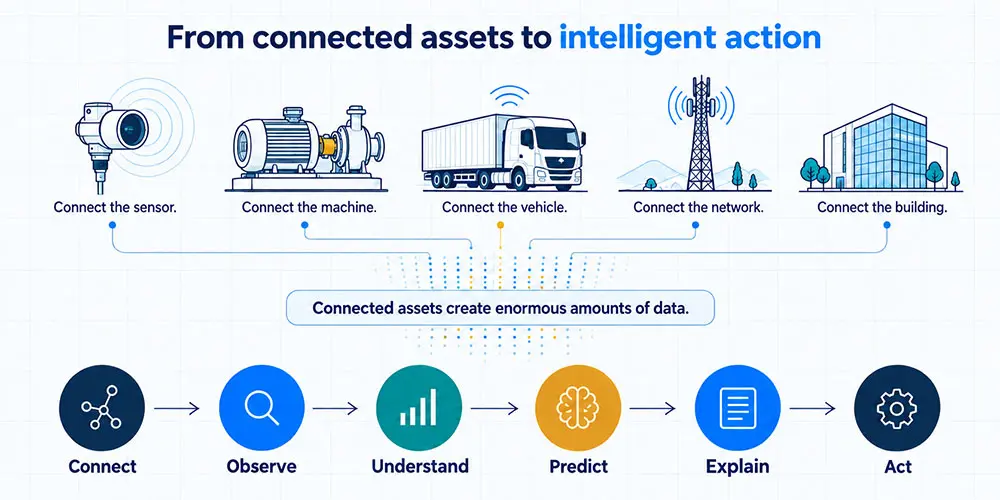
That created enormous amounts of data.
The next phase is about understanding that data in the context of the physical asset.
At MicroAI, we see the progression as:
Connect → Observe → Understand → Predict → Explain → Act
A machine should not simply report a value. Teams should be able to ask why the value changed.
A network should not simply generate an alarm. Operators should understand what is affected and what caused the fault.
A data center should not simply produce thousands of infrastructure metrics. Teams should be able to understand how power, cooling, servers, networks, and applications relate to each other.
This is where IoT, edge AI, machine learning, and agentic AI begin to converge.
MicroAI builds AI agents for industrial operations around machines, applications, networks, data centers, and infrastructure so teams can connect live signals with documentation, history, and operational knowledge.
Frequently Asked Questions About IoT
What does IoT stand for?
IoT stands for Internet of Things. It refers to connected physical devices that collect, exchange, and use data through networks and software systems.
What is a simple example of IoT?
A smart thermostat is a simple IoT example. It measures temperature, connects to a network, sends information to software, and can automatically change the heating or cooling system.
What are examples of industrial IoT?
Industrial IoT examples include connected manufacturing machines, PLCs, robots, motors, pumps, compressors, injection molding machines, production lines, smart meters, network equipment, and infrastructure sensors.
What is the difference between IoT and IIoT?
IoT covers connected devices broadly. IIoT, or Industrial Internet of Things, specifically refers to connected machines, sensors, equipment, and systems used in manufacturing and other industrial environments.
What is the difference between IoT and AIoT?
IoT connects devices and collects information. AIoT adds artificial intelligence so connected systems can interpret data, detect faults, predict outcomes, and support decisions or actions.
What is an IoT platform?
An IoT platform connects devices with software used for data ingestion, management, analytics, monitoring, security, visualization, and automation.
What are IoT sensors?
IoT sensors measure physical conditions such as temperature, vibration, pressure, humidity, motion, current, location, or images and send those measurements to connected systems.
What is an IoT gateway?
An IoT gateway connects devices with networks and computing systems. It can collect data, translate protocols, filter information, provide security, and perform local edge processing.
What is edge computing in IoT?
Edge computing processes IoT information close to the device instead of sending every raw signal to a remote cloud. This can improve response times, reduce data movement, and allow local systems to continue operating with limited connectivity.
How is IoT used in manufacturing?
How is IoT related to predictive maintenance?
How is AI used with IoT?
What is an industrial IoT platform?
What is IoT in a smart factory?
What is predictive IoT?
What is IoT monitoring?
What is IoT analytics?
What is IoT automation?
What is IoT device management?
Are IoT devices secure?
What is the future of IoT?
Turn IoT Data Into Operational Intelligence
Connecting devices is only the beginning.
MicroAI brings intelligence to machines, networks, applications, data centers, and infrastructure so teams can understand what their connected assets are telling them.
Build an agent around a machine, device, network, or operational system. Connect its live data and knowledge. Ask what changed, why it matters, and what should happen next.