

- Agentic AI in Manufacturing Integration Guide
- What Agentic AI Means in Manufacturing
- Agentic AI Compared With Automation Predictive AI and GenAI
- Why Manufacturers Are Integrating AI Agents
- How Agentic AI Integrates With Manufacturing Systems
- The Agentic Decision Loop on the Factory Floor
- Agentic AI Use Cases in Manufacturing
- Levels of Autonomy for Manufacturing AI Agents
- How to Implement Agentic AI in Manufacturing
- Security Safety and Governance Requirements
- How to Measure Agentic AI Performance and ROI
- Building Manufacturing AI Agents With MicroAI
- Frequently asked questions
Agentic AI in Manufacturing Integration Guide
Agentic AI in manufacturing connects real-time machine data, plant systems, technical documents, and operational workflows so AI agents can understand conditions, recommend actions, and complete approved tasks. Instead of stopping at a dashboard or alert, an agentic system can investigate the likely cause of a problem, determine the next step, notify the right team, create a work order, adjust a schedule, or issue a bounded supervisory instruction.
Manufacturers can integrate these systems with existing PLC, SCADA, historian, MES, CMMS, QMS, ERP, industrial IoT, and edge infrastructure. The goal is not to replace deterministic machine controls. It is to add a governed intelligence layer that helps plants reduce downtime, improve quality and throughput, preserve operational knowledge, and respond faster when conditions change. MicroAI applies this approach through manufacturing AI solutions and industrial AI agents for operations.
What Agentic AI Means in Manufacturing
Agentic AI in manufacturing is a software system that observes an industrial environment, reasons about operational goals and constraints, plans a sequence of steps, and uses approved tools to carry out or coordinate those steps. A manufacturing AI agent may be built around one machine, production line, maintenance process, quality workflow, or factory-wide objective.
The word agentic describes goal-directed behavior. The system can continue working through a problem instead of waiting for a new prompt at every stage. It may collect additional data, compare current behavior with historical patterns, consult an equipment manual, check the production schedule, request approval, update another system, and verify whether the action resolved the issue.
A practical manufacturing agent combines five capabilities:
- Observe live and historical conditions across machines, sensors, controllers, applications, and plant systems.
- Reason across telemetry, alarms, operating limits, maintenance history, production context, and technical documentation.
- Plan the next steps needed to reach a defined operational goal or resolve an exception.
- Act through allowlisted tools such as alerts, tickets, work orders, inspection requests, schedule updates, or bounded control instructions.
- Verify the result, record the decision path, and use approved feedback to improve future recommendations.
Agentic AI Compared With Automation Predictive AI and GenAI
Traditional automation, predictive AI, generative AI, and agentic AI can all support factory operations, but they perform different jobs. Many effective manufacturing systems combine them rather than treating them as competing technologies.
| Technology | Primary job | Typical output | Manufacturing example |
|---|---|---|---|
| Rules-based automation | Executes predefined logic | A fixed command or sequence | A PLC stops a conveyor when a safety input changes |
| Predictive AI | Estimates what is likely to happen | A score, forecast, or detected condition | A model estimates bearing failure risk from vibration and temperature |
| Generative AI | Creates or summarizes information | Text, instructions, explanations, or generated content | A model summarizes a maintenance log or drafts a troubleshooting procedure |
| Agentic AI | Pursues a goal and coordinates approved steps | A decision, workflow, or completed task | An agent investigates a fault, opens a work order, alerts maintenance, and checks the result |
Generative models often provide the language and reasoning interface inside an agentic system. Predictive models estimate machine health, quality risk, or production outcomes. Rules, policies, and deterministic controls define what the agent may do. An industrial large language model can make plant data and documentation easier to query, while the agentic layer coordinates the tools and actions needed to complete a task.
Why Manufacturers Are Integrating AI Agents
Factories already generate extensive operational data, but the information is usually divided among machine controllers, SCADA screens, historians, MES records, maintenance systems, quality databases, spreadsheets, manuals, and experienced employees. Teams often receive an alert without the context needed to identify the cause or decide what to do next.
Manufacturing AI integration closes that gap by linking operational signals with asset history, production priorities, technical knowledge, and connected workflows. This creates 360 degree machine visibility and gives an agent enough context to explain what changed, why it matters, which assets or orders are affected, and what response is allowed.
The most common business reasons for deploying AI agents in manufacturing include:
- Reducing the time between fault detection, diagnosis, and action
- Improving planned maintenance and reducing avoidable unplanned downtime
- Identifying the operating conditions associated with scrap, rework, and quality loss
- Replanning production when machines, labor, materials, or priorities change
- Giving operators and technicians faster access to manuals, procedures, and past resolutions
- Coordinating work across production, maintenance, quality, engineering, and supply chain systems
- Moving from isolated alerts to approved operational outcomes
How Agentic AI Integrates With Manufacturing Systems
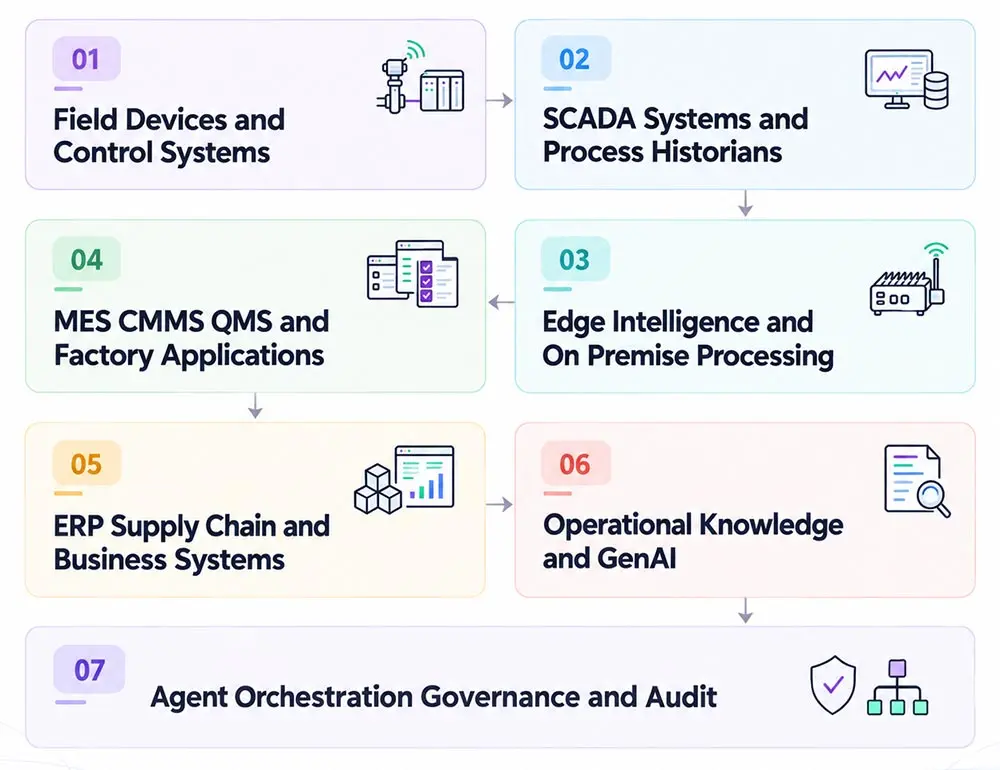
A manufacturing agent should be integrated as a supervisory intelligence and orchestration layer around existing operational technology and business systems. The ISA-95 model offers a useful way to understand these connections, from field devices and control systems through manufacturing operations and enterprise planning.
Field Devices and Control Systems
Sensors, actuators, CNC machines, robots, drives, programmable logic controllers, and distributed control systems provide the real-time operating data used by an agent. Connections may use OPC UA, Modbus TCP, EtherNet/IP, MQTT, database connectors, secure gateways, or vendor APIs. The exact method depends on the asset and the controls already in place. The growing range of industrial IoT examples shows how connected machines can supply the data foundation for plant intelligence.
Time-critical machine logic, safety interlocks, and emergency shutdown functions should remain in deterministic control and safety systems. The agent can analyze controller data and propose or dispatch approved supervisory actions without bypassing hard process limits.
SCADA Systems and Process Historians
SCADA systems and historians supply tags, alarms, trends, setpoints, batch context, and equipment states. An agent can correlate related events, distinguish symptoms from likely causes, summarize what changed before a stoppage, and prioritize the conditions that need attention. If write access is permitted, any command should follow the established SCADA to PLC path and pass through validation, permissions, and operating constraints.
Edge Intelligence and On Premise Processing
Edge processing places models and agent services on or near the equipment generating the data. This can reduce network dependency, keep sensitive operational data inside the plant, and support faster analysis of high-frequency signals. Lightweight AI can extend fault detection, health scoring, process monitoring, and optimization to gateways and constrained industrial devices. MicroAI AtomML is designed for embedded and edge-native machine intelligence.
MES CMMS QMS and Factory Applications
Manufacturing execution systems provide work orders, equipment status, production counts, material genealogy, schedules, downtime codes, and OEE data. A computerized maintenance management system contributes maintenance history, technician notes, parts, labor, and open work. Quality systems add inspection results, control limits, nonconformance records, and corrective actions.
By connecting these systems, an agent can determine whether a developing equipment fault threatens a specific order, recommend the least disruptive maintenance window, create a work request, and give planners updated information. A factory management system can consolidate equipment health, production performance, faults, and maintenance priorities across factory operations.
ERP Supply Chain and Business Systems
ERP, warehouse, procurement, and supply chain applications provide order priorities, inventory, material availability, supplier status, costs, and customer commitments. Secure API integration lets an agent evaluate the operational and business impact of a plant event. For example, it can identify which orders are at risk when a machine becomes unavailable, check whether an alternate line has the required tooling and material, and prepare a replanning recommendation.
Operational Knowledge and GenAI
Manuals, standard operating procedures, troubleshooting guides, shift notes, maintenance records, alarm histories, and engineering documents contain context that telemetry alone cannot provide. A retrieval layer can index approved content and give the agent relevant passages when it investigates a problem. Responses should remain grounded in controlled documents, identify the source used, respect document permissions, and avoid treating outdated instructions as current procedure.
Agent Orchestration Governance and Audit
The orchestration layer gives the agent access to approved data sources and tools, defines the sequence of actions it may take, and records every decision. Policies specify which conditions require human approval, which systems are read only, which actions are allowed, and when the agent must stop or escalate. This layer also manages identity, memory, versioning, confidence thresholds, and audit records.
The Agentic Decision Loop on the Factory Floor
A manufacturing AI agent typically follows a repeatable decision loop. The loop can run in advisory mode, approval-required mode, or bounded autonomous mode depending on the risk of the action.
- Observe the current state by collecting relevant telemetry, alarms, production events, work orders, and system status.
- Add operational context from asset history, recipes, schedules, manuals, quality records, and maintenance activity.
- Identify the likely cause and impact by comparing current conditions with normal behavior, prior events, operating limits, and active production requirements.
- Select an allowed response using policies, priorities, safety constraints, and the tools available to the agent.
- Request approval or act by notifying a person, opening a work order, routing an inspection, updating a schedule, or issuing a bounded supervisory instruction.
- Verify and document the outcome by checking whether conditions improved and recording the evidence, action, owner, and result.
For example, an agent monitoring a machining center could detect a change in spindle current and cycle time, compare the pattern with earlier maintenance events, consult the machine manual, identify a likely lubrication issue, recommend an inspection, open a CMMS work order after approval, and verify whether performance returned to its expected range after service.
Agentic AI Use Cases in Manufacturing
Predictive Maintenance and Machine Health
A maintenance agent can monitor condition data, fault patterns, process context, alarms, and service history to identify developing equipment problems. It can explain the evidence behind the finding, compare maintenance options, check parts and labor availability, and create an approved work order. MicroAI Machine Intelligence and predictive manufacturing connect machine behavior with maintenance and production decisions.
Downtime Investigation and Root Cause Analysis
An agent can reconstruct the events before a line stopped by correlating controller states, alarms, operator notes, upstream and downstream conditions, recent changes, and maintenance history. It can separate the first observed symptom from the most likely initiating cause and provide the supporting evidence to maintenance and engineering teams.
Quality Inspection and Process Control
Quality agents can connect inspection results and AI enabled vision with machine settings, materials, recipes, environmental conditions, and equipment behavior. When defects or process drift appear, the agent can identify the affected products, recommend an inspection or containment step, notify the correct team, and help trace the conditions associated with scrap or rework.
Production Scheduling and WIP Routing
A production agent can continuously evaluate machine availability, work in process, labor, tooling, material readiness, changeover requirements, and due dates. When a constraint changes, it can simulate alternatives and recommend a revised sequence. Approved changes can be written back through the MES or planning system so the updated plan remains visible to the people who own production.
OEE Throughput and Cycle Time Improvement
An OEE agent can explain availability, performance, and quality losses across machines, lines, shifts, molds, recipes, or products. It can detect changes in cycle time, microstops, speed loss, starvation, blockage, or recurring quality events and connect them with the operational conditions most likely to be responsible.
Operator and Technician Knowledge
A knowledge agent gives plant employees a conversational way to use approved manuals, procedures, troubleshooting records, and experienced-worker knowledge. It can answer equipment-specific questions, retrieve the correct procedure, summarize similar past events, and guide a technician through the next approved check without replacing formal training or safety requirements.
Inventory and Supply Chain Coordination
An agent can connect plant conditions with material availability, supplier updates, inventory levels, production orders, and customer commitments. It may flag a developing shortage, identify which schedules are affected, recommend alternate sourcing or production options, and prepare the necessary updates for planners to approve.
Energy and Resource Optimization
Energy agents can analyze the relationship between production demand and the behavior of compressors, ovens, HVAC systems, pumps, motors, and other energy-intensive equipment. They can recommend load shifts, identify avoidable consumption, and coordinate approved adjustments while preserving throughput, product quality, and equipment constraints.
Compliance Records and Operational Reporting
Agents can collect approved evidence from production, quality, maintenance, and business systems to draft shift reports, maintenance summaries, nonconformance records, or audit documentation. A person should review consequential records before release, and the system should retain links to the underlying source data and document version.
Levels of Autonomy for Manufacturing AI Agents
Manufacturers do not need to begin with closed-loop control. Autonomy can increase only after the agent has shown reliable performance within a clearly defined operating boundary.
| Level | Agent behavior | Suitable examples | Human role |
|---|---|---|---|
| Insight | Monitors and explains conditions | Health scores, fault detection, trend summaries | Reviews findings |
| Recommendation | Proposes a next step and supporting evidence | Inspection advice, maintenance timing, schedule options | Chooses the action |
| Approved action | Executes a task after explicit approval | Create work order, route alert, request inspection | Approves each action |
| Bounded autonomy | Acts inside defined limits and escalates exceptions | Reorder within limits, adjust noncritical settings, reroute WIP | Sets policy and monitors outcomes |
How to Implement Agentic AI in Manufacturing
The most reliable path starts with one bounded operational problem, not a plant-wide autonomy program. The first deployment should have a measurable baseline, accessible data, a clear process owner, and a response that can be validated by the people who perform the work.
- Choose one operational outcome such as shorter fault diagnosis, fewer repeat failures, improved first-pass yield, or better schedule adherence.
- Select one asset or workflow with sufficient data, frequent enough events, and a team willing to validate the agent’s findings.
- Map the systems and data including PLC or SCADA tags, historian records, MES events, CMMS history, manuals, permissions, owners, and data quality gaps.
- Define the operating boundary by documenting approved tools, prohibited actions, hard limits, escalation paths, approval rules, and rollback procedures.
- Begin in read only or advisory mode so subject matter experts can compare recommendations with actual plant conditions before any workflow is automated.
- Validate the agent with real scenarios including normal operation, known failures, ambiguous conditions, missing data, conflicting instructions, and communication outages.
- Connect one approved action such as creating a work order, sending a targeted alert, opening an inspection request, or drafting a schedule change.
- Measure and expand by comparing operational and agent performance with the baseline before adding assets, tools, users, or autonomy.
Teams that are still defining their first use case can begin with AIStudio to ingest operational data, visualize behavior, evaluate models, and build intelligence around a specific equipment or factory problem. The broader guide to AI in manufacturing operations can help teams choose a use case tied to a measurable plant outcome.
Security Safety and Governance Requirements
Agentic AI introduces new decision paths and system access, so manufacturing deployments need controls for both operational safety and cybersecurity. The agent should never become an undocumented route around established engineering ownership, change management, or safety systems.
A production-ready governance model should include:
- Separation of control and intelligence so PLC logic, safety instrumented systems, and hard interlocks retain authority over time-critical and safety-critical functions.
- Least-privilege access with unique identities, role-based permissions, network segmentation, and only the tools required for the assigned job.
- Allowlisted actions that limit the agent to approved systems, commands, values, frequencies, and operating windows.
- Human approval for actions with safety, quality, production, financial, regulatory, or customer impact.
- Input and output validation for missing data, stale data, conflicting sources, out-of-range values, model uncertainty, and unauthorized instructions.
- Complete audit records covering the data used, reasoning summary, model and policy version, action requested, approver, executed step, and observed result.
- Fallback and rollback including read-only mode, manual control, safe-state behavior, and a tested method for reversing nonphysical changes.
- Ongoing monitoring for false alerts, missed conditions, drift, user overrides, tool failures, access changes, and unexpected behavior.
ISA/IEC 62443 provides a useful framework for industrial automation and control system cybersecurity, while ISA-95 helps define the boundaries and information flow between control, manufacturing operations, and enterprise systems. AI governance should also define ownership, testing, transparency, human oversight, incident response, and the conditions required to suspend or retire an agent.
How to Measure Agentic AI Performance and ROI
A manufacturing agent should be measured against the operational outcome it was built to improve and against the quality of its own decisions. Establish the baseline before the pilot and use the same definitions, time windows, and asset scope after deployment.
Useful manufacturing metrics include:
- Maintenance unplanned downtime, mean time between failures, mean time to repair, planned versus unplanned work, repeat failures, and maintenance lead time.
- Production OEE, throughput, cycle time, schedule attainment, changeover time, microstops, and bottleneck duration.
- Quality first-pass yield, scrap, rework, defect escape rate, deviation duration, and time to containment.
- Energy per unit, peak demand, idle consumption, and energy cost by asset, product, batch, or shift.
- Workforce time to diagnose, first-time resolution, time spent searching for information, and successful knowledge reuse across shifts.
- Agent performance false-alert rate, missed-event rate, recommendation acceptance, override frequency, action completion, escalation accuracy, and time from detection to action.
The business case should count integration, validation, change management, support, model monitoring, and governance costs. A pilot is ready to scale when the operational metric improves, the agent remains reliable across expected conditions, the team trusts the evidence, and the controls work as designed.
Building Manufacturing AI Agents With MicroAI
MicroAI builds industrial AI agents around specific equipment, production processes, and operational jobs. An agent can combine live machine signals, historical behavior, manuals, maintenance records, procedures, and plant context to answer questions, detect developing faults, explain changes, recommend next steps, and support approved workflows.
A practical starting point is one machine or line with a clear problem such as recurring downtime, slow troubleshooting, maintenance risk, cycle-time drift, or quality loss. Once the agent performs reliably and delivers a measurable result, the same architecture can expand to additional assets, workflows, and locations.
Start with one device Prompt one device for free
Continue your research Explore MicroAI manufacturing and industrial AI white papers
Frequently Asked Questions
What Is Agentic AI in Manufacturing?
Agentic AI in manufacturing uses AI agents to observe plant conditions, reason across operational data and business context, plan the steps needed to reach a goal, and carry out approved actions. The agent may monitor equipment, investigate faults, coordinate maintenance, support quality workflows, replan production, or retrieve technical knowledge.
How Is Agentic AI Different From Generative AI?
Generative AI creates or summarizes content in response to a prompt. Agentic AI can continue through a multi-step task, choose among approved tools, take an action, check the result, and escalate when necessary. A manufacturing agent may use a generative model to understand a manual or explain a finding, but the agentic system manages the complete workflow.
Can Agentic AI Integrate With Existing PLC SCADA and MES Systems?
Yes. Manufacturing AI agents can connect to existing systems through protocols, gateways, APIs, databases, and message brokers supported by the plant architecture. Common integration points include OPC UA, Modbus TCP, EtherNet/IP, MQTT, REST APIs, GraphQL APIs, historians, and vendor-specific interfaces. The available method depends on the equipment, controls, security policy, and data ownership.
Does Agentic AI Replace PLCs SCADA MES or CMMS?
No. An agentic layer can complement existing control and manufacturing applications by connecting their information, explaining conditions, coordinating approved tasks, and writing back through established interfaces. PLCs and safety systems should retain deterministic control, while MES, CMMS, QMS, and ERP systems remain the systems of record for their assigned processes.
What Are the Best First Agentic AI Use Cases for a Factory?
Strong first use cases have a clear owner, measurable baseline, accessible data, frequent enough events, and a bounded response. Predictive maintenance, downtime investigation, operator knowledge search, quality triage, work-order creation, and OEE loss analysis often meet these conditions. The best choice depends on the plant’s largest recurring operational constraint.
How Can Manufacturers Keep AI Agents Safe?
Manufacturers can limit risk by separating AI from safety-critical control, using least-privilege access, allowlisting tools and actions, validating inputs and outputs, requiring approval for consequential actions, logging every decision, testing fallback modes, and monitoring the agent after deployment. Autonomy should increase only after performance has been validated within the intended operating range.
Why Use Edge AI for Manufacturing Agents?
Edge AI processes selected data on or near industrial equipment. It can reduce latency and network dependency, limit the amount of operational data sent outside the plant, and keep essential analysis available during a connectivity interruption. Cloud and enterprise systems may still be used for coordination, fleet-wide learning, reporting, and model management.
What Data Does a Manufacturing AI Agent Need?
The required data depends on the job. A maintenance agent may need sensor history, alarms, operating states, work orders, parts, and manuals. A production agent may need schedules, machine status, WIP, labor, materials, and due dates. A quality agent may need inspection results, process settings, recipes, images, material genealogy, and nonconformance records. Clear asset identities and aligned timestamps are essential across these sources.
How Should Manufacturers Measure Agentic AI ROI?
Measure the agent against the operational KPI selected before deployment, such as downtime, mean time to repair, first-pass yield, scrap, schedule attainment, cycle time, energy per unit, or time to diagnose. Track agent quality as well, including false alerts, missed events, recommendation acceptance, overrides, escalation accuracy, and time from detection to action.