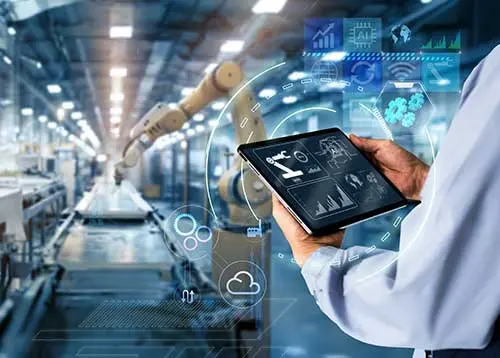
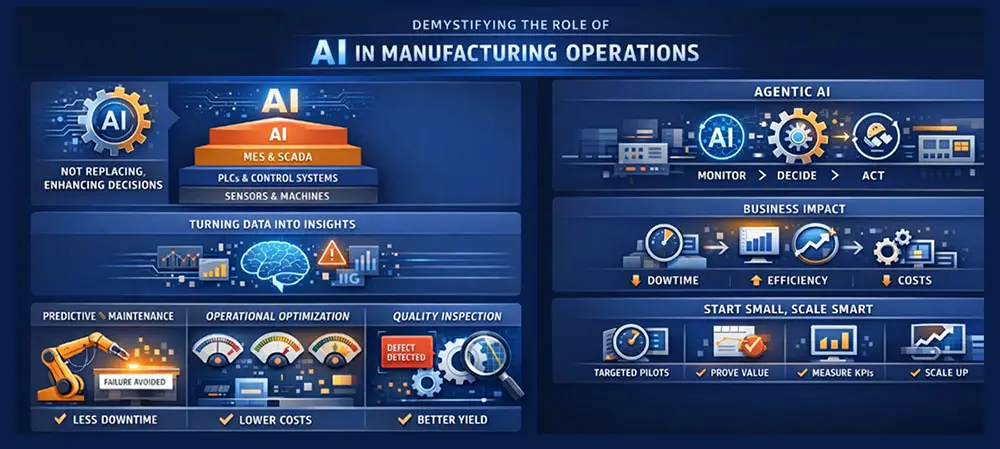
At its core, AI in manufacturing is not about replacing people or control systems—it is about enhancing decision-making. Traditional manufacturing environments already rely on automation, programmable logic controllers (PLCs), and manufacturing execution systems (MES). AI resides above these systems, analyzing vast amounts of operational data to detect patterns, predict outcomes, and recommend and/or take autonomous actions.
Predictive Maintenance
One of the most impactful applications of AI is predictive maintenance. Rather than relying on fixed maintenance schedules or merely reacting to failures after they occur, AI models analyze sensor data such as vibration, temperature, pressure, and energy usage to predict when manufacturing assets are likely to fail. This allows maintenance teams to intervene at the optimal time, reducing unplanned downtime, extending asset life, and lowering maintenance costs. AI does not replace maintenance expertise—it augments it with more timely and more accurate insights.
Quality Assurance
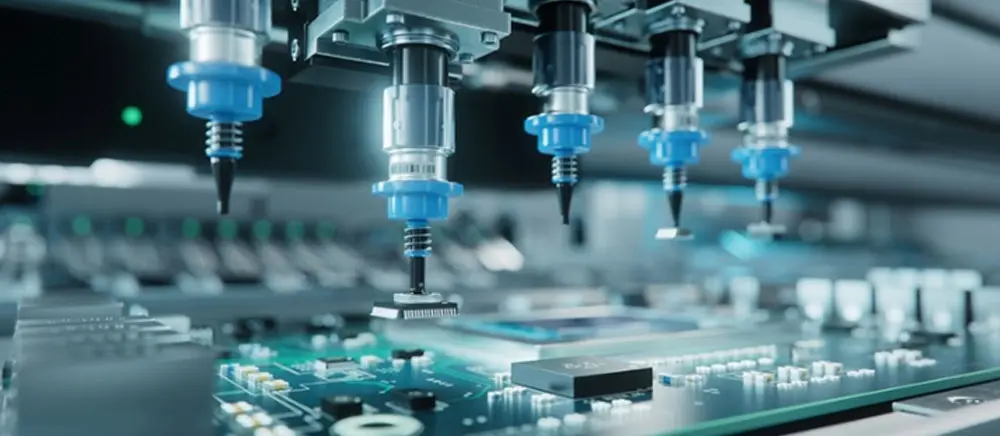
AI also plays a critical role in quality management. Computer vision models can inspect products at speeds and levels of consistency that are difficult to achieve manually. By detecting defects earlier in the process, manufacturers can reduce rework, prevent defective products from reaching customers, and uncover upstream process issues that drive quality variation. Over time, AI systems learn which process conditions are most likely to produce defects, enabling proactive quality control.
Operational Optimization
Manufacturing operations are full of trade-offs: throughput versus quality, energy efficiency versus output, and cost versus speed. AI can continuously evaluate these competing variables in real time, identifying optimal operating conditions based on current constraints. For example, AI can dynamically adjust production parameters to reduce scrap, optimize energy usage during peak demand periods, or rebalance production schedules when disruptions occur.
Agentic AI
More advanced implementations introduce Agentic AI—edge-based AI agents that not only analyze and recommend actions but can autonomously execute tasks within defined guardrails. These agents can monitor production lines, coordinate maintenance activities, respond to anomalies, and escalate issues when human intervention is required.
Ultimately, the role of AI in manufacturing is evolutionary, not revolutionary. Successful manufacturers start with well-defined use cases tied to measurable business outcomes such as reduced downtime, improved yield, or faster recovery from disruptions. When deployed thoughtfully, AI becomes a force multiplier—turning data into actionable intelligence and helping manufacturing teams operate with greater confidence, efficiency, and agility in an increasingly complex industrial landscape.
To provide the best experiences, we use technologies like cookies to store and/or access device information. Consenting to these technologies will allow us to process data such as browsing behavior or unique IDs on this site. Not consenting or withdrawing consent, may adversely affect certain features and functions.
Functional
Always active
The technical storage or access is strictly necessary for the legitimate purpose of enabling the use of a specific service explicitly requested by the subscriber or user, or for the sole purpose of carrying out the transmission of a communication over an electronic communications network.
Preferences
The technical storage or access is necessary for the legitimate purpose of storing preferences that are not requested by the subscriber or user.
Statistics
The technical storage or access that is used exclusively for statistical purposes.The technical storage or access that is used exclusively for anonymous statistical purposes. Without a subpoena, voluntary compliance on the part of your Internet Service Provider, or additional records from a third party, information stored or retrieved for this purpose alone cannot usually be used to identify you.
Marketing
The technical storage or access is required to create user profiles to send advertising, or to track the user on a website or across several websites for similar marketing purposes.