



Lightweight AI: What It Is, How It Works, and Where It’s Used
LIGHTWEIGHT AI IN BRIEF
- Lightweight AI is the umbrella term for machine learning models engineered to run on hardware with limited compute, memory, and power — microcontrollers, sensors, gateways, PLCs, cameras, and industrial edge devices — instead of in a data center.
- Edge AI, TinyML, on-device AI, and embedded AI are subsets of it, distinguished by how small the target hardware is and where the model physically sits.
- Models are made lightweight through quantization, pruning, and knowledge distillation — typically producing a 4x to 8x reduction in model size at a small, measurable accuracy cost.
- The 2026 shift: lightweight AI is no longer only perception (vision, vibration, anomaly detection). Small language models now run on edge hardware, and NPU-equipped microcontrollers have made transformer inference viable outside the data center.
- In industrial operations, the payoff is sub-second local decisions, sharply lower data transmission and cloud cost, and data that never leaves the plant — the reason MicroAI built AtomML™ to run natively on the asset itself.
What is lightweight AI?
Lightweight AI is artificial intelligence built to run on hardware that cannot support conventional models. Instead of requiring GPUs and cloud infrastructure, lightweight models are compressed and optimized to execute on microcontrollers, embedded processors, and edge devices with limited memory, processing power, and available energy.
The constraint is not accuracy — it is resources. A lightweight model performs a specific, well-scoped task (detect this fault signature, classify this defect, flag this network anomaly) using a fraction of the compute a general-purpose model would demand. That trade is deliberate: in industrial environments, a narrow model that answers in 10 milliseconds on the machine is worth more than a broad model that answers in 800 milliseconds from a region three time zones away.
Three technology categories sit underneath the term:
- Edge AI — inference that happens on or near the asset generating the data, rather than in the cloud. Read our full primer on what edge AI is and how it works.
- TinyML — machine learning small enough to run on microcontrollers and other very low-power silicon, often with kilobytes of RAM.
- Distilled and compressed models — larger models reduced into smaller, faster versions that retain most of their original capability.
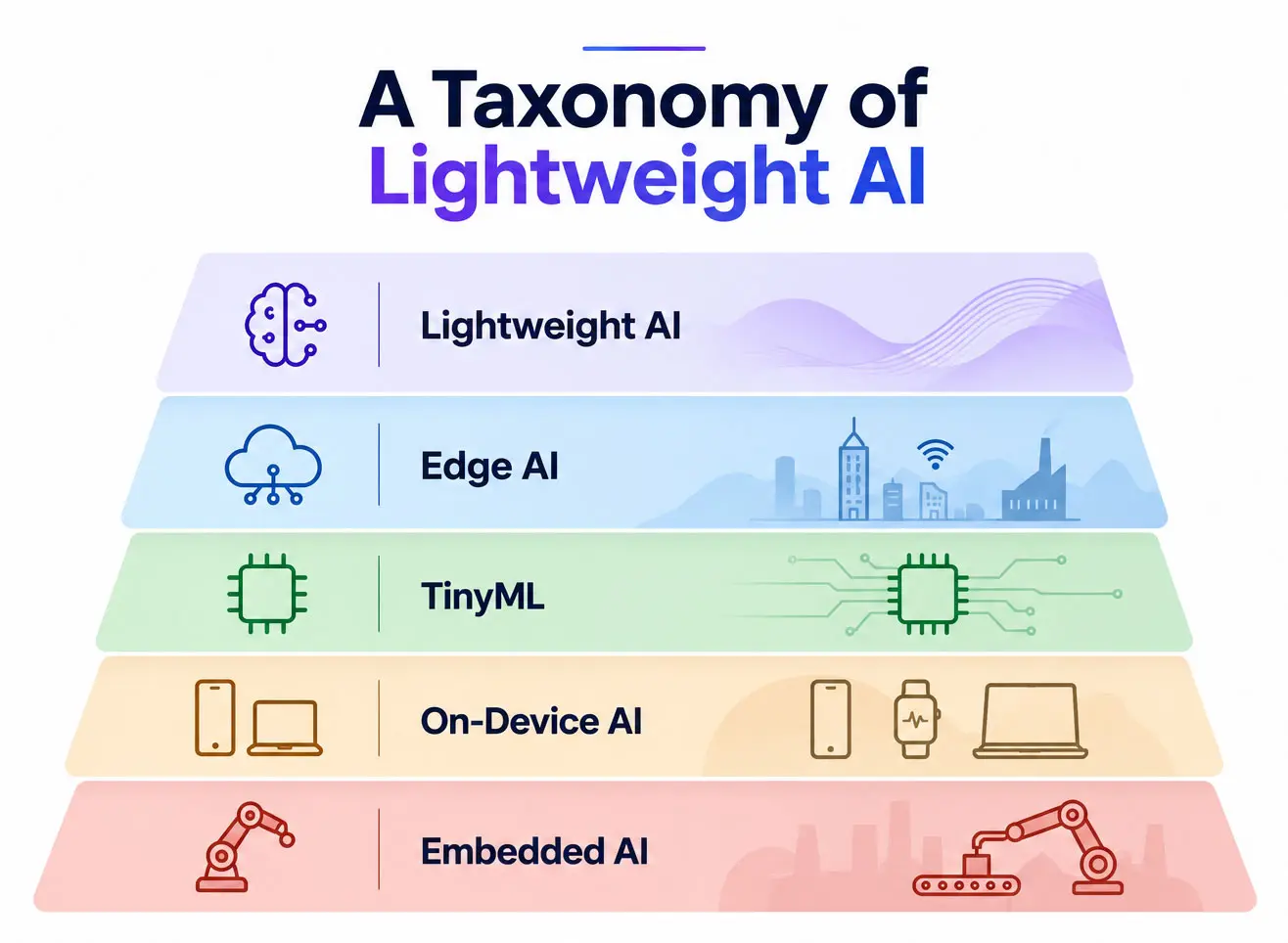
Lightweight AI vs. edge AI vs. TinyML vs. on-device AI vs. embedded AI
These five terms are used interchangeably across most of the industry, and that imprecision costs engineering teams real time during procurement and architecture reviews. They are not synonyms. They describe different scales and different deployment locations.
| Term | What it actually describes | Typical hardware | Typical model size | Example workload |
|---|---|---|---|---|
| Lightweight AI | The umbrella category: any model engineered for constrained compute, memory, or power | Anything from an 8-bit MCU to an edge server | Kilobytes to a few gigabytes | Any of the below |
| Edge AI | Where inference runs — on or near the data source rather than in the cloud | Gateways, industrial PCs, edge servers, smart cameras | Megabytes to gigabytes | Multi-camera visual inspection on a line |
| TinyML | The smallest tier — ML on microcontrollers and ultra-low-power silicon | MCUs (Cortex-M class), often battery or harvested power | Tens to hundreds of kilobytes | Vibration-based bearing fault detection on a motor |
| On-device AI | Inference contained entirely within an end-user device, with no network round trip | Phones, wearables, handhelds, laptops | Megabytes to gigabytes | Wake-word detection; on-phone transcription |
| Embedded AI | AI compiled into a product’s firmware as a permanent function of the device | MCUs, SoCs, ASICs inside a finished product | Kilobytes to megabytes | A pump that ships with self-diagnostics built in |
The practical distinctions worth remembering:
- Edge AI is about location. TinyML is about size. A model can be both — most TinyML is edge AI — but a 2 GB vision model on an edge server is edge AI and is emphatically not TinyML.
- Embedded AI has a second, unrelated meaning in the software industry: AI features embedded into a SaaS application. In an industrial context it means AI in device firmware. Confirm which definition a vendor is using before you compare architectures.
- On-device AI is the consumer-facing framing of the same engineering problem. In industrial settings the equivalent term is endpoint AI — intelligence resident on the asset itself.
- MicroAI’s own architectural position sits at the smallest tier, which we call edge-native AI: the model is trained and run on the endpoint, not shipped to it from elsewhere.
Why lightweight AI matters more in 2026 than it did in 2024
Two things changed, and together they moved lightweight AI from a niche embedded-systems discipline into a mainstream deployment strategy.
Small language models arrived at the edge. Until recently, lightweight AI meant perception: vision, audio, vibration, and sensor anomaly detection. The compression techniques developed for those models turned out to work on generative ones. A 4-billion-parameter model quantized to INT4 lands around 2 GB rather than roughly 8 GB — small enough to run at conversational speed on single-board hardware or an accelerator module. Google’s Gemma edge variants, Microsoft’s Phi-4-mini, and Alibaba’s small Qwen series are all built for this tier. Gartner projects that by 2027, organizations will use small, task-specific AI models roughly three times more than general-purpose LLMs.
Neural processing units became standard silicon, not exotic silicon. Arm’s Ethos-U55 and Ethos-U85 microNPUs brought dedicated neural acceleration to microcontroller-class devices, with the U85 reaching approximately 4 TOPS and adding native transformer operator support — the specific capability that makes generative inference outside a data center practical. STMicroelectronics now ships its Neural-ART NPU in the STM32N6 as part of a mainstream MCU portfolio. Discrete accelerators such as the Hailo-8L put double-digit TOPS onto a single-board computer for a few hundred dollars.
The upshot: the floor on what qualifies as “capable enough to run useful AI” dropped sharply. Hardware you already have deployed in the field may now be a viable inference target — which reframes lightweight AI from a research question into a fleet-upgrade question.
How is an AI model made lightweight?
Three compression techniques do most of the work, and they are not interchangeable. Each trades something different, and production deployments usually combine them.
Quantization
Quantization reduces the numerical precision used to represent a model’s weights and activations — most commonly from 32-bit floating point down to 8-bit integers (INT8), and increasingly to 4-bit (INT4) for language models. Because integer arithmetic is dramatically cheaper than floating-point, the result is a smaller model that also runs faster on hardware without a floating-point unit. INT8 is the de facto standard for edge accelerators. Quantization-aware training, which simulates the precision loss during training rather than applying it afterward, recovers most of the accuracy that post-training quantization gives up.
Pruning
Pruning removes parameters that contribute little to the model’s output — individual weights, whole channels, or entire structural blocks. Unstructured pruning yields the highest theoretical compression but needs sparse-execution support to translate into real speedup; structured pruning removes whole units and delivers speedup on ordinary hardware. Pruning is typically followed by a fine-tuning pass to let the remaining parameters compensate.
Knowledge distillation
Distillation trains a small “student” model to reproduce the behavior of a large “teacher” model, learning from the teacher’s output distributions rather than only from labeled data. The student is architecturally smaller from the outset rather than a reduced version of the teacher, which often preserves accuracy better than compressing the large model directly — at the cost of a full training cycle.
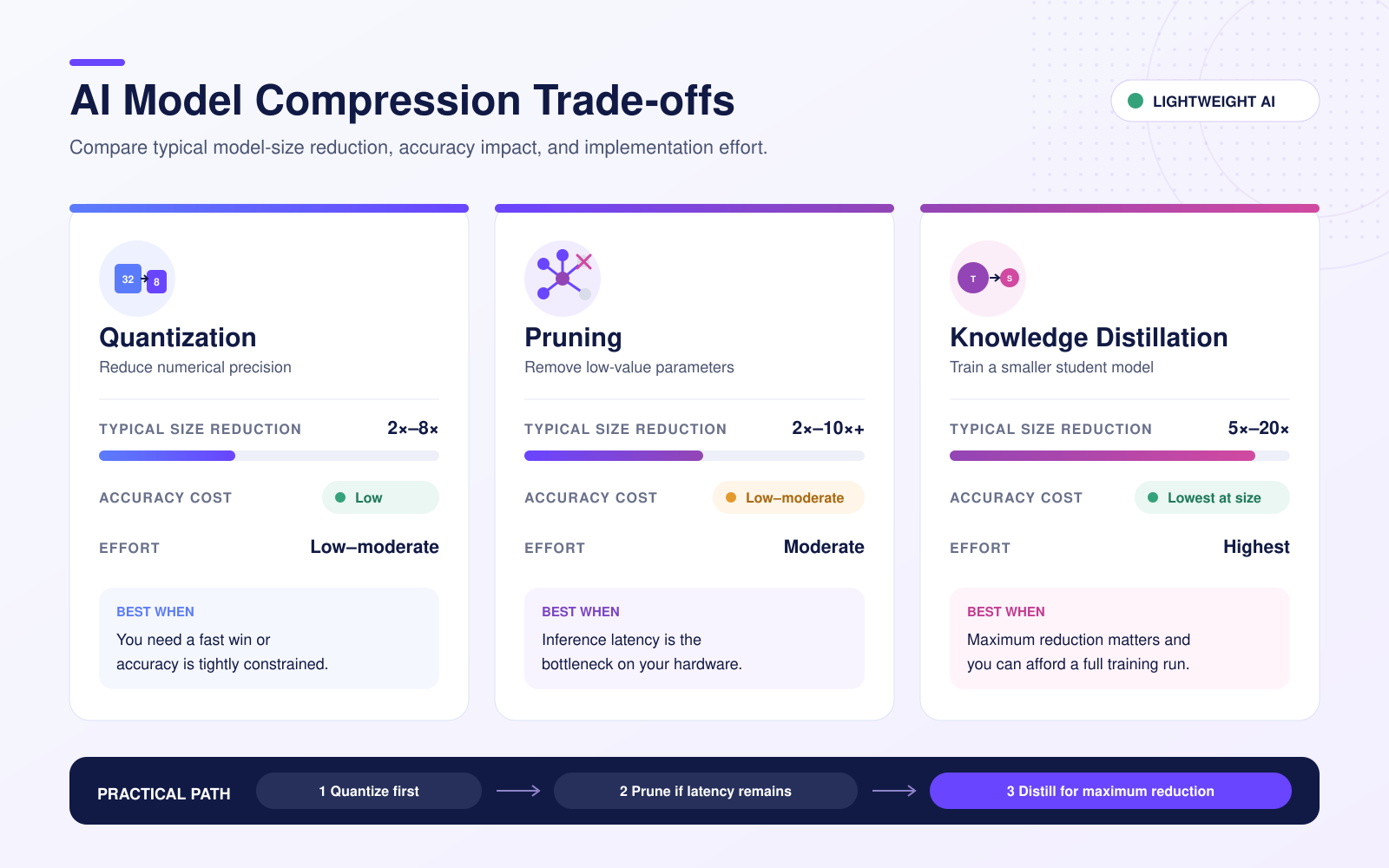
Which technique should you use?
| Technique | What it reduces | Typical size reduction | Accuracy cost | Effort | Best when |
|---|---|---|---|---|---|
| Quantization (post-training) | Numerical precision | 2x–4x (FP32→INT8) | Low; usually a small single-digit accuracy drop | Lowest — no retraining | You need a fast win and have a trained model in hand |
| Quantization-aware training | Numerical precision | 2x–4x, up to 8x at INT4 | Very low | Moderate — requires retraining | Accuracy is tight and you control the training pipeline |
| Structured pruning | Parameter count | 2x–10x depending on aggressiveness | Moderate; recoverable with fine-tuning | Moderate | Your bottleneck is inference latency on standard hardware |
| Unstructured pruning | Parameter count | Up to 10x+ | Low at moderate sparsity | Moderate | Your runtime supports sparse execution |
| Knowledge distillation | Model architecture | 5x–20x | Lowest of the three at equivalent size | Highest — full training run | You have a strong teacher model and time to train |
| Combined pipeline | All of the above | 10x+ | Depends on ordering | Highest | Production deployment on tightly constrained hardware |
A commonly cited working figure for industrial deployments is a 4x to 8x reduction in deployment footprint from quantization alone. Newer research is pushing into sub-4-bit territory — ternary and 1.58-bit formats such as BitNet — but these are not yet standard in production industrial stacks.
For teams evaluating this in an asset-optimization context, our white paper on AI-enabled data modeling for asset optimization covers how model design choices flow through to machine and network performance outcomes.
What hardware does lightweight AI run on?
Matching the model to the silicon is the decision that determines whether a deployment works. These are the practical tiers.
| Tier | Hardware | Available memory | Rough capability | Workloads that fit |
|---|---|---|---|---|
| Microcontroller (TinyML) | Cortex-M class MCUs | Tens to hundreds of KB RAM | Sub-1 GOPS | Keyword spotting (tens of KB), vibration anomaly detection, simple sensor classification |
| MCU + microNPU | STM32N6, Ethos-U55/U85-equipped MCUs | Hundreds of KB to a few MB | ~0.1–4 TOPS | Person detection (a few hundred KB), small CNNs, basic on-device audio |
| Single-board computer | Raspberry Pi 5 class | 4–16 GB RAM | CPU-bound | Multi-model pipelines, quantized SLMs at modest speed |
| SBC + discrete accelerator | Hailo-8L / 10H, Coral, Jetson-class | 8–32 GB | ~10–25 TOPS | Real-time multi-stream vision, INT4 language models |
| Industrial edge server | Ruggedized x86/ARM at the plant | 32 GB+ | GPU-class | Fleet-wide inference, local model retraining, digital twin execution |
Two useful anchors for scoping: a keyword-spotting model fits in tens of kilobytes; a person-detection model fits in a few hundred kilobytes. In August 2026 a developer demonstrated a 28.9-million-parameter language model running on a roughly $10 ESP32-S3 microcontroller by storing the embedding table in flash — a useful marker of how far the floor has dropped, though not a production pattern.
MicroAI’s AtomML™ is engineered for the first two tiers, embedding directly onto MCU and MPU-class hardware. AtomML+™ covers agentless deployment across IT and OT assets where firmware-level installation is not an option. Our post on AI at the extreme edge covers the microcontroller case in more depth.

Where is lightweight AI used?
Industrial operations and manufacturing
Lightweight AI embedded into production assets monitors performance, health, and security continuously, at the machine, without shipping raw telemetry anywhere.
- Application: Real-time monitoring of industrial assets — machines, controllers, networks — with fault detection and corrective-action recommendation happening locally.
- Example: A lightweight model embedded on a CNC controller learns that asset’s normal vibration, current draw, and thermal signature, then flags deviation as a developing fault and scores asset health continuously. No cloud round trip, so the detection window is milliseconds rather than minutes.
- Benefit: Predictive maintenance programs of this kind are reported to reduce unplanned downtime by up to 40%, and automated visual quality inspection to improve defect capture by up to 30%. MicroAI’s own deployments show data handling and transmission costs falling 70–80% when inference moves onto the asset — and on the output side, a 15% improvement in OEE can equate to a 17% increase in productivity, taking an operation producing $60M of product to roughly $70M.
See how this works in practice on predictive manufacturing and asset observability, or read the Factory Management System overview.
Infrastructure, energy, and utilities
- Application: Distributed assets — substations, pipelines, pumping stations, remote grid equipment — that are expensive or impossible to reach and often have poor connectivity.
- Example: An embedded model on a grid asset detects a developing fault and triggers local isolation without waiting for a central SCADA decision.
- Benefit: Assets stay intelligent when the network does not cooperate. Lightweight AI is the only architecture that works at all when bandwidth is intermittent or metered. More on infrastructure and power and utilities.
Telecom networks
- Application: Network quality of service, fault prediction, and service assurance at the network edge.y
- Example: Lightweight models on network elements predict service degradation before subscribers experience it, enabling pre-emptive remediation.
- Benefit: SLA compliance improves without the cost of centralizing every network telemetry stream. See network quality of service.
Automotive and connected vehicles
- Application: In-vehicle cybersecurity, component health monitoring, and driver-assistance functions that cannot tolerate network latency.
- Example: An embedded model monitors CAN bus traffic for intrusion signatures and responds locally in milliseconds.
- Benefit: Safety-critical decisions do not depend on connectivity. See automotive.
Data centers
- Application: Thermal, power, and GPU infrastructure monitoring at rack and device level.
- Example: Lightweight models on cooling and power equipment detect drift toward thermal limits before thresholds trip.
- Benefit: Faster response, and monitoring telemetry that does not itself become a bandwidth problem. See AI for data centers.
IoT and smart home devices
- Application: Smart cameras, home assistants, wearables, and connected appliances.
- Example: A thermostat that learns occupancy and preference patterns on-device and adjusts without sending behavioral data to a cloud service.
- Benefit: Lower transmission cost, faster response, and behavioral data that stays on the device.
Agriculture
- Application: AI-equipped drones and environmental sensors across growing operations.
- Example: A drone identifies plant disease, pest pressure, and irrigation status in real time while flying, processing imagery locally and surfacing actionable findings immediately.
- Benefit: Decisions in the field, in the moment, without dependence on rural connectivity.
Health monitoring
- Application: Wearable trackers and portable diagnostic devices.
- Example: An ECG wearable analyzes cardiac rhythm on-device and alerts the wearer to irregularities as they occur.
- Benefit: No continuous transmission of physiological data, which improves both privacy posture and response time..
What are the benefits of lightweight AI?
Lower latency. Inference happens where the data is created, removing the network round trip entirely. For closed-loop control, fault mitigation, and safety functions, this is often the difference between a system that works and one that does not.
Lower cost. Cutting data transmission, cloud storage, and server-side inference out of the loop removes the largest recurring line items in a conventional AI deployment. In MicroAI deployments, data handling costs drop 70–80% when inference moves to the asset.
Privacy and data sovereignty by architecture. Data processed locally never leaves the site. That is a structural answer to data-residency requirements rather than a policy control layered on top — an increasingly important distinction under GDPR, HIPAA, and regional data-protection regimes.
Energy efficiency. Specialized low-power AI silicon is materially more efficient per operation than general-purpose CPUs and GPUs. Dell’s 2024 Innovation Catalysts research found 73% of organizations were moving AI inferencing toward edge environments specifically to improve energy efficiency.
Resilience. A lightweight model keeps working when the network does not. For remote, mobile, and mission-critical assets this is a hard requirement, not an optimization.
Scalability. Per-device inference cost is near zero once deployed, so scaling from 100 assets to 100,000 does not scale your cloud bill proportionally. Given that roughly 75% of enterprise-managed data is now created outside traditional data centers, this is where the economics increasingly point.
What are the challenges and limitations of lightweight AI?
Vendors rarely publish this section. It is the one buyers actually need.
Accuracy ceilings. Compression costs accuracy. Usually a small amount, sometimes not — but on tasks with high intrinsic complexity or long-tail edge cases, a compressed model will underperform its full-size counterpart. Establish an acceptable accuracy floor before you compress, not after.
Model management across a fleet. Updating one cloud model is trivial. Updating 40,000 deployed devices with intermittent connectivity, mixed firmware versions, and no rollback path is an operational discipline in its own right. Over-the-air update infrastructure is a prerequisite, not an afterthought.
Hardware fragmentation. A model optimized for one NPU does not automatically run on another. Toolchains, supported operators, and quantization behavior differ by vendor, and porting is real engineering work.
Narrow task scope. Lightweight models do specific things well. A general-purpose model that handles many tasks acceptably is a different product. Scope creep on an edge model usually ends in a size problem.
Limited on-device retraining. Most edge hardware can run inference but cannot train. Retraining generally requires a hybrid architecture — local inference, centralized or federated retraining — which reintroduces some of the cloud dependency you were trying to remove.
Debugging and observability. When a model misbehaves on a device in a remote facility, you have far less visibility than you would in a cloud environment. Plan instrumentation up front.
Physical environment. Industrial edge hardware lives with heat, vibration, dust, and power instability. Silicon selection is as much an environmental question as a compute one.
Training vs. inference: the distinction that drives most architecture decisions
This is the single most common source of confusion in edge AI procurement.
Training is where a model learns — computationally expensive, data-hungry, and almost always done on powerful hardware. Inference is where a trained model is applied to new data to produce an output — comparatively cheap and fast.
Most lightweight AI deployments do training centrally and inference locally. That is the standard hybrid pattern: train in the cloud or on a plant-level server, compress, deploy to the endpoint, run inference there.
MicroAI’s edge-native approach differs in one important respect: the model builds its behavioral baseline on the asset itself, from that asset’s own data, rather than arriving pre-trained on someone else’s fleet. This matters because two nominally identical machines in different plants do not behave identically, and a model trained on aggregate data treats individual variation as noise. Our comparison of edge vs. cloud for predictive maintenance covers the trade-offs in detail.
Lightweight AI, data sovereignty, and the 2026 regulatory picture
Local processing has become a compliance architecture, not just a performance one.
Under the EU AI Act as amended by the Digital Omnibus agreement, transparency obligations — including disclosure requirements and machine-readable marking of AI-generated content — apply from August 2, 2026. High-risk obligations were postponed: standalone high-risk systems under Annex III to December 2, 2027, and high-risk AI embedded in regulated products under Annex I to August 2, 2028. Prohibitions and AI literacy requirements have been in force since February 2025, with market surveillance enforcement powers arriving August 2026.
The durable point for a lightweight AI strategy is simpler than the timeline. When inference happens on the asset, operational data does not cross a border, enter a third-party environment, or accumulate in a repository you have to defend. Data residency becomes a property of the architecture. For organizations operating across multiple jurisdictions, that is materially easier to evidence than a data-handling policy. See also our post on edge and endpoint AI as an answer to the data security challenge.
How MicroAI delivers lightweight AI?
MicroAI was built for this tier of hardware rather than adapted down to it.
AtomML™ embeds directly onto MCU and MPU-class silicon inside the asset. It builds a behavioral model of that specific machine from its own live data, scores health continuously, and detects deviation locally — reducing data handling and transmission costs by 70–80% relative to cloud-centric monitoring.
AtomML+™ covers assets where firmware-level installation is not possible, delivering agentless machine learning across IT and OT estates including cyber-threat detection.
Machine Intelligence, Intelligent Vision, and Security and Monitoring agents apply this foundation to specific operational problems, and AIStudio handles the modeling and deployment workflow.
We describe the underlying philosophy as Weightless AI — AI that deploys in weeks rather than months because it does not require the infrastructure buildout a conventional deployment assumes.
Frequently asked questions about lightweight AI
Is TinyML the same as edge AI?
No. TinyML describes model size — machine learning small enough to run on microcontrollers, often in tens or hundreds of kilobytes. Edge AI describes location — inference running on or near the data source rather than in the cloud. Most TinyML is edge AI, but plenty of edge AI is far too large to be TinyML.
What is the difference between edge AI and edge computing?
Edge computing is the general practice of processing data near where it is generated. Edge AI is the specific case of running machine learning inference in that location. Edge computing is the infrastructure; edge AI is one workload that runs on it.
Can AI run without an internet connection?
Yes. That is the central point of lightweight AI. Once a model is deployed to a device, inference runs entirely locally with no network dependency. Connectivity is needed only to push model updates or export results — and both can be batched, deferred, or done on a maintenance visit.
Do you need a GPU to run AI at the edge?
Often not. Quantized models run efficiently on integer arithmetic, which ordinary CPUs and microcontrollers handle well. Dedicated NPUs improve throughput substantially and are now common in edge silicon, but many industrial workloads — vibration analysis, anomaly detection, sensor classification — run acceptably on MCU-class hardware with no accelerator at all.
How much accuracy does quantization cost?
Typically a small single-digit percentage drop for INT8 post-training quantization, and often near zero with quantization-aware training. The loss grows at lower precision and varies substantially by task and architecture. Benchmark against your own acceptance criteria — published figures are not transferable across use cases.
When should you choose quantization vs. pruning vs. knowledge distillation?
Quantization first: it is the cheapest to apply and requires no retraining. Add structured pruning when inference latency remains the bottleneck on standard hardware. Reach for knowledge distillation when you need the largest size reduction at the lowest accuracy cost and can afford a full training cycle. Production deployments on tight hardware usually combine all three.
How small can an AI model be and still be useful?
Genuinely small. Keyword spotting fits in tens of kilobytes. Person detection fits in a few hundred kilobytes. Industrial anomaly detection on a single sensor stream can be smaller still. Usefulness is a function of how narrowly the task is scoped, not of parameter count.
Can language models run on edge hardware?
Yes, within limits. A 4-billion-parameter model quantized to INT4 occupies roughly 2 GB and runs at usable speed on single-board hardware or with an accelerator module. Transformer-capable NPUs have brought smaller language models onto microcontroller-class silicon. What does not yet fit at this tier is frontier-scale generative capability.
What are the main limitations of lightweight AI?
Compression costs some accuracy; fleet-wide model updates are an operational burden; hardware toolchains are fragmented and porting between them is real work; models are narrow by design; and most edge devices can run inference but cannot retrain. See the challenges section above for the full picture.
Why does lightweight AI matter for manufacturing specifically?
Because manufacturing decisions are time-bound and the data volume is enormous. A fault signature that matters for 200 milliseconds cannot survive a cloud round trip, and streaming full-rate telemetry from every asset to a data center is economically indefensible. Lightweight AI puts the decision where the machine is. See predictive manufacturing and our manufacturing solutions overview.
Bringing it together
Lightweight AI is the umbrella under which edge AI, TinyML, on-device AI, and embedded AI all sit. What unites them is a design constraint — limited compute, memory, and power — and what they deliver is a set of properties that cloud AI structurally cannot: decisions in milliseconds, costs that do not scale with fleet size, and data that never leaves the site.
The 2026 change is that the constraint got looser. NPU-equipped microcontrollers and INT4 quantization have brought workloads onto edge hardware that were data-center-only two years ago, including small language models. For industrial operators, that means assets already in the field are candidates for intelligence they could not previously support.
Next steps:
- Read the white paper on embedded and edge AI in industrial transformation
- Read the white paper on AI-enabled data modeling for asset optimization
- Explore AtomML™ for endpoint deployment, or AtomML+™ for agentless coverage
- See lightweight AI applied to predictive manufacturing, asset observability, and industrial AI agents