


What Is Artificial Intelligence
Artificial intelligence, or AI, is a field of computer science focused on building systems that can perform tasks that usually require human intelligence. These tasks include recognizing images and speech, understanding language, finding patterns, making predictions, recommending actions, and controlling physical equipment.
AI is the broad category. Machine learning is one way to build AI systems from data. Deep learning is a type of machine learning that uses multilayer neural networks. Generative AI creates new content, while AI agents combine models, data, rules, and software tools to complete a goal or support a workflow.
Most AI in use today is narrow AI, meaning it performs a defined task within a limited context. In industrial operations, that task might be detecting a developing machine fault, estimating maintenance needs, inspecting a product, forecasting production, or explaining equipment behavior to an operator.
In This Guide
- What artificial intelligence means and how AI works
- The difference between AI, machine learning, deep learning, and neural networks
- How supervised, unsupervised, and reinforcement learning differ
- What generative AI and agentic AI do
- How edge AI differs from cloud AI
- How AI is used in manufacturing and other industrial environments
- What to evaluate before starting an AI project
What Is Artificial Intelligence
Artificial intelligence is technology that allows a computer, software application, machine, or device to perform a task associated with human intelligence. Depending on the application, an AI system may perceive its environment, interpret language, learn from examples, predict an outcome, recommend a decision, or take an approved action.
AI does not need to think like a person to be useful. A model that identifies a defect in a camera image, estimates the remaining useful life of a motor, or ranks likely causes of a network problem can create value without possessing general intelligence or consciousness.
AI systems can work with many kinds of input, including text, images, audio, video, application logs, maintenance records, and time-series sensor data. Connected equipment supplies much of this operational data. For a broader look at connected devices and the data they produce, see these real-world IoT examples.
How Artificial Intelligence Works
There is no single AI process. A rules engine, a machine learning model, a large language model, and an industrial AI agent work differently. Most practical AI systems, however, follow a similar lifecycle.
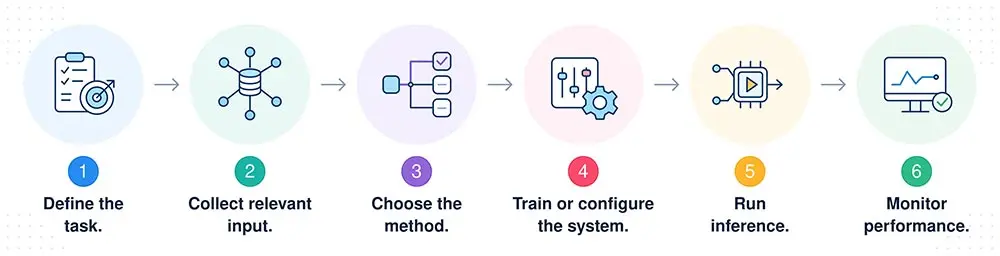
- Define the task.
Start with a specific outcome, such as classifying a defect, forecasting demand, detecting a machine fault, or answering a technician’s question. - Collect relevant input.
The system may use historical records, live sensor readings, images, text, audio, operating conditions, or a combination of these sources. - Choose the method.
Some tasks can be handled with explicit rules. Others need machine learning, deep learning, generative AI, or a combination of models and software tools. - Train or configure the system.
Machine learning models learn patterns from examples. Generative AI applications may use a pretrained model connected to trusted company data. Rule-based systems are configured with human-defined logic. - Run inference.
Inference is the point at which the trained or configured system receives new input and produces a prediction, classification, recommendation, answer, or action. - Monitor performance.
Teams validate outputs, track errors, watch for changing data or operating conditions, and retrain or adjust the system when necessary.
A model does not automatically become accurate simply because it sees more data. Data quality, labels, operating context, validation, and ongoing monitoring all affect performance. A production AI system also needs clear rules for when a person must review or approve an output.
AI Machine Learning Deep Learning and Generative AI
The easiest way to understand these terms is as related layers. Artificial intelligence is the largest category. Machine learning sits inside AI, deep learning sits inside machine learning, and many modern generative AI systems are built with deep learning. Agentic AI describes how one or more models can be combined with context, tools, and workflows to pursue a defined goal.
| Term | How it relates | What it does | Industrial example |
|---|---|---|---|
| Artificial intelligence | The broad field | Enables software or machines to perform tasks involving perception, language, prediction, reasoning, or action | A system that explains why a machine changed behavior and recommends what to inspect |
| Machine learning | A subset of AI | Learns statistical patterns from data to classify, predict, rank, or estimate | A model that estimates equipment health from vibration, temperature, current, and load |
| Neural network | A family of machine learning models | Processes information through connected layers of weighted nodes | A model that recognizes complex relationships among multiple sensor signals |
| Deep learning | A subset of machine learning based on multilayer neural networks | Learns complex features from large or unstructured data such as images, audio, and text | A vision model that classifies surface defects from production images |
| Generative AI | Usually built with deep learning and foundation models | Creates or transforms text, images, code, audio, and other content | An assistant that summarizes manuals, work orders, and live operating context for a technician |
| Agentic AI | An AI system design that combines models with context, tools, rules, and workflows | Pursues a defined goal through multiple steps and can call approved tools | An industrial agent that investigates a fault, gathers supporting evidence, and proposes the next action |
The Main Types of Artificial Intelligence
There is no single official list of AI types. The right classification depends on whether you are describing capability, learning method, model architecture, or application. Two classifications are especially useful for business and industrial teams.
AI Types by Capability
- Narrow AI.
Narrow AI is designed for a particular task or domain. Recommendation engines, fraud detection models, vision inspection systems, predictive maintenance models, and language assistants are examples. Nearly every AI system deployed today is narrow AI. - Artificial general intelligence.
Artificial general intelligence, or AGI, refers to a theoretical system that could learn and apply knowledge across a broad range of tasks at a human level. Current AI products, including advanced generative AI systems, are not AGI.
AI Types by Method
Common methods include rules-based AI, machine learning, neural networks, deep learning, generative AI, computer vision, natural language processing, and agentic systems. These categories overlap. For example, an industrial AI agent may use a language model to interpret a question, a machine learning model to estimate equipment health, and a rules engine to control which actions are permitted.
What Is Machine Learning
Machine learning is a subset of artificial intelligence in which algorithms learn patterns from data and use those patterns to make predictions or decisions about new input. Instead of writing a separate rule for every possible condition, developers train a model on examples that represent the task.
In an industrial setting, a machine learning model might learn the relationship among vibration, temperature, current, speed, load, and prior maintenance events. It can then estimate equipment condition or flag a change that deserves investigation. MicroAI’s Machine Intelligence brings signals, operating context, and machine history together so teams can understand health and performance at the equipment level.
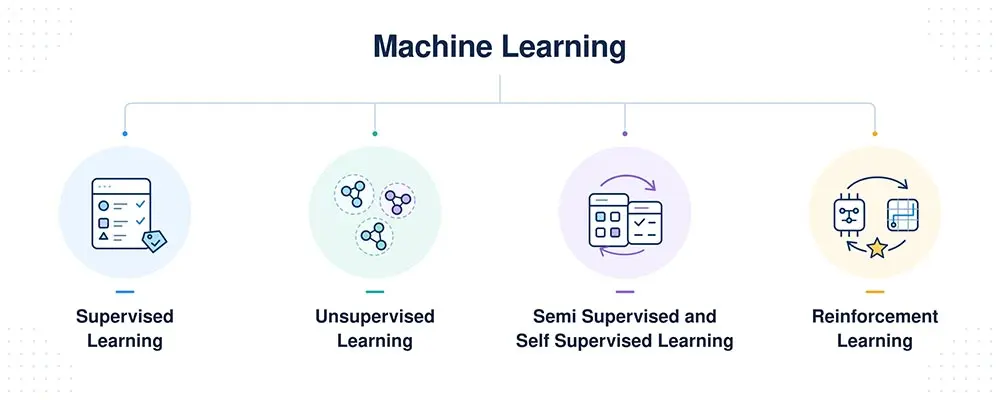
- Supervised Learning
Supervised learning trains a model with labeled examples. Each example includes an input and the correct output. A manufacturer might train a model with product images labeled pass or fail, or with historical machine records labeled by fault type. Classification predicts a category, while regression predicts a numeric value such as temperature, energy demand, cycle time, or remaining useful life. - Unsupervised Learning
Unsupervised learning works with data that does not have predetermined labels. The model searches for structure, clusters, relationships, or patterns that differ from the rest of the data. In a factory, it can help separate operating modes, group machines with similar behavior, or surface patterns that engineers have not previously labeled. - Semi Supervised and Self Supervised Learning
Semi-supervised learning combines a smaller labeled data set with a larger unlabeled data set. Self-supervised learning creates learning signals from the data itself. These approaches are useful when labeling every image, document, or sensor sequence would be slow or expensive. - Reinforcement Learning
Reinforcement learning trains a system through actions and feedback. The model learns which actions produce higher rewards over time. It can support robotics, scheduling, process control, and resource optimization, but industrial use requires carefully defined constraints, simulation, testing, and safety controls before a model is allowed to influence live equipment.Teams developing predictive models from operational data can use AIStudio to move from complex data toward models that support forecasting and operational decisions.
Machine Learning Versus Deep Learning
Deep learning is machine learning that uses neural networks with multiple processing layers. Those layers can learn complex features from raw or lightly processed data. Deep learning is especially useful for images, audio, natural language, and other high-dimensional data where relationships are difficult to define manually.
Deep learning is not automatically better than traditional machine learning. A smaller machine learning model may be faster, easier to explain, less expensive to run, and more practical on constrained hardware. Deep learning often needs more data and computing power, although transfer learning, model compression, and specialized processors can reduce those requirements.
Use traditional machine learning when the data is structured, the task is well defined, training data is limited, explainability matters, or the model must run on modest hardware.
Use deep learning when the task involves complex images, audio, text, video, or sensor relationships and enough representative data and compute are available.
Both approaches require validation. A deep learning model does not independently know whether every prediction is correct. Teams measure performance on data the model did not train on and continue monitoring after deployment.
What Is Generative AI
Generative AI creates new content or transforms existing content in response to an instruction. It can generate or summarize text, produce images, write code, organize information, and translate between formats. Large language models, or LLMs, are generative models trained to process and produce language.
Traditional predictive AI usually answers questions such as what is likely to happen, which category an item belongs to, or whether a measurement is outside an expected range. Generative AI can explain those findings in natural language, summarize related records, or draft recommended steps. See how generative AI is used in manufacturing to connect operational data with the way technicians and plant leaders ask questions.
Generative AI can produce confident but incorrect statements. Industrial applications should ground responses in trusted manuals, live signals, maintenance records, runbooks, and other approved sources. Important recommendations should include supporting context and remain subject to the organization’s review and authorization rules.
What Are AI Agents and Agentic AI
An AI agent is a software system that uses a model, relevant context, and available tools to pursue a defined goal. It may retrieve information, compare evidence, plan a sequence of steps, call approved software, and report a result. Agentic AI refers to systems designed around this goal-directed behavior, sometimes with multiple specialized agents working together.
A chatbot mainly responds to a prompt. An operational AI agent can connect a question to live data, equipment history, technical documentation, and a controlled workflow. For example, an agent could investigate a drop in output, identify the machines affected, compare recent signals with normal behavior, find a relevant maintenance procedure, and propose the next checks for a technician.
MicroAI enables teams to build industrial AI agents around specific machines, production lines, networks, servers, and operational processes. The scope, tools, permissions, and human approval points should be defined for each agent.
Edge AI Versus Cloud AI
Edge AI runs AI inference on or near the device, machine, camera, gateway, server, or network element that produces the data. Cloud AI sends data to remote infrastructure for processing. Many production systems use both in a hybrid architecture.
Edge AI can reduce response time, bandwidth use, and dependence on a continuous connection. It can also keep sensitive operational data closer to the source. Cloud systems are useful for large-scale training, centralized management, long-term storage, and analysis across many sites. The right design depends on latency, connectivity, privacy, hardware, model size, and operating cost.
When computing resources are limited, lightweight AI uses compressed or purpose-built models designed for constrained hardware. MicroAI AtomML places machine learning on the device or machine, while AtomML+ provides centralized intelligence across groups of IT and OT assets.
How AI and IoT Work Together
The Internet of Things, or IoT, connects physical devices so they can collect and exchange data. AI interprets that data and turns it into predictions, explanations, recommendations, or automated responses. The combination is often called AIoT.
A connected motor may report vibration, current, temperature, speed, and load. IoT provides the connection and data flow. AI learns how the motor behaves under different conditions, detects a developing fault pattern, estimates risk, and gives the maintenance team useful context. Edge AI can perform part of that analysis locally, while a cloud or enterprise platform compares behavior across machines and sites.
Real World Applications of Artificial Intelligence
AI is already used across consumer products, enterprise software, and physical operations. Common examples include recommendation systems, speech recognition, document search, fraud detection, cybersecurity monitoring, demand forecasting, route planning, quality inspection, predictive maintenance, and robotics.
How AI Is Used in Manufacturing
Manufacturing AI applies machine learning, computer vision, generative AI, and AI agents to production equipment, lines, utilities, quality systems, and plant workflows. Practical applications include the following.
- Machine health monitoring and fault detection. Models analyze vibration, temperature, pressure, current, energy use, output, and other signals to identify changes that deserve attention.
- Predictive maintenance. AI can estimate developing risk and help maintenance teams prioritize inspections and planned work. Learn how AI supports predictive maintenance.
- Visual quality inspection. Computer vision can inspect parts, packaging, surfaces, labels, and process steps. MicroAI AI-enabled vision processes visual information at the edge for operational use cases.
- Root cause investigation. AI can compare current signals with history, maintenance events, operating conditions, and technical documents to rank likely causes and show supporting evidence.
- Production and OEE improvement. Models can identify recurring losses, cycle-time variation, bottlenecks, and relationships among availability, performance, and quality. Explore MicroAI’s manufacturing AI solutions.
- Asset observability. AI can combine health, performance, and security context across industrial equipment and enterprise assets. See how asset observability moves beyond static monitoring.
- Operational knowledge access. Generative AI can help technicians find information in manuals, work orders, maintenance history, and runbooks without searching across disconnected systems.
- Predictive operations. Teams can use signals and historical context to anticipate production needs, maintenance demand, quality risk, and process constraints. MicroAI’s predictive manufacturing approach brings that intelligence closer to equipment and processes.
AI in Networks Data Centers and Critical Infrastructure
The same principles apply beyond the factory. AI can monitor network quality, application performance, server health, power use, cooling, capacity, and security events. Models can identify changes in behavior, connect related evidence, prioritize affected assets, and help operators investigate problems faster. Edge processing is especially useful when response time, bandwidth, data control, or intermittent connectivity matters.
Benefits of Artificial Intelligence for Operations
AI can help operations teams make better use of information they already collect. The value comes from improving a measurable decision or workflow, not from adding AI for its own sake.
- Earlier visibility into equipment and process changes
- Faster fault investigation and root cause identification
- More focused maintenance planning and fewer unnecessary inspections
- More consistent quality checks across products, lines, and shifts
- Better use of sensor, maintenance, application, and network data
- Lower data-transfer requirements when inference runs at the edge
- Easier access to technical knowledge for operators and technicians
- Scalable monitoring across industrial equipment and enterprise assets
Results depend on the quality of the data, the clarity of the use case, the fit between the model and the task, integration with daily work, and whether teams act on the output. A small, well-defined deployment can outperform a broad AI program with no clear operational owner.
Limitations and Risks of AI
AI systems have limits. They can reflect incomplete or biased data, lose accuracy as conditions change, produce false alerts, miss important events, or generate statements that sound plausible but are wrong. They can also create security, privacy, compliance, and integration risks if they are deployed without controls.
Industrial AI requires particular care because an incorrect recommendation can affect production, quality, safety, or equipment. Organizations should define data ownership, access controls, validation procedures, model monitoring, escalation paths, and human approval requirements before connecting AI to operational actions.
Explainability should match the decision. An operator may need to see which signal changed, when it changed, how far it moved from expected behavior, which machines are affected, and which records support the conclusion. A score without context is often not enough.
How to Choose the Right AI Approach
Start with the operational decision, not the model. A useful AI project has a specific user, a defined input, a measurable outcome, and a clear way to act on the result.
- Name the problem.
Define the task in operational terms, such as reducing time to diagnose a recurring motor fault or improving defect detection on one line. - Set a baseline.
Measure current downtime, investigation time, false-alert rate, scrap, cycle time, energy use, or another relevant outcome before the pilot. - Assess the data.
Confirm that the necessary signals, labels, records, images, or documents are available and represent the conditions the system will encounter. - Match the method to the task.
Use rules for stable logic, traditional machine learning for structured prediction, deep learning for complex unstructured data, generative AI for language and content, and agents for controlled multistep workflows. - Choose edge cloud or hybrid deployment.
Consider latency, connectivity, privacy, bandwidth, hardware limits, model size, and the need to compare assets across locations. - Define human oversight.
Specify which outputs are advisory, which actions require approval, and how users can challenge or correct the system. - Pilot on a narrow scope.
Begin with one machine, line, server, or network workflow, validate the result, and expand only after the operating team trusts the output.
Artificial Intelligence at the Machine Level
MicroAI brings intelligence to industrial equipment, networks, and critical infrastructure, helping teams operate more efficiently and resolve problems faster. Its edge agents and generative AI capabilities connect live signals, history, documents, and operating context so people can monitor health, investigate faults, understand root causes, and decide what to do next.
A practical place to begin is one asset and one question. Prompt one device for free and see how an AI agent can turn equipment data into answers your team can use.
Frequently Asked Questions About IoT
What Is Artificial Intelligence in Simple Terms?
Artificial intelligence is technology that enables software or machines to perform tasks that normally require human abilities, such as recognizing patterns, understanding language, making predictions, recommending actions, or controlling equipment. Most AI today is designed for a specific task rather than general human-like intelligence.
What Is the Difference Between AI and Machine Learning?
AI is the broad field of building systems that perform intelligent tasks. Machine learning is a subset of AI that learns patterns from data. An AI system can use machine learning, but it can also use explicit rules, search, optimization, or other methods.
What Is the Difference Between Machine Learning and Deep Learning?
Deep learning is a type of machine learning that uses multilayer neural networks. Traditional machine learning often works well with structured data and fewer computing resources. Deep learning is commonly used for complex images, audio, text, video, and high-dimensional sensor data.
Is All Artificial Intelligence Deep Learning?
No. AI includes rules-based systems, search, optimization, traditional machine learning, neural networks, deep learning, generative AI, and agentic systems. Deep learning is one part of AI and is not the best choice for every task.
What Is Generative AI?
Generative AI creates or transforms content such as text, images, audio, video, and code. In industrial operations, it can summarize records, answer questions using manuals and live context, explain model findings, and help teams find relevant procedures. Its output should be grounded in trusted data and reviewed when the decision is important.
What Is Agentic AI?
Agentic AI combines models with context, tools, rules, and workflows so a system can pursue a defined goal through multiple steps. An industrial AI agent might collect equipment data, compare it with history, search technical documents, rank likely causes, and recommend the next check within approved permissions.
What Is Edge AI?
Edge AI runs model inference on or near the device that creates the data. It can reduce latency, bandwidth use, and dependence on cloud connectivity. Edge AI is useful for machines, cameras, gateways, servers, networks, and other systems that need fast local decisions or tighter control of operational data.
How Is AI Used in Manufacturing?
Manufacturers use AI for machine health monitoring, fault detection, predictive maintenance, visual quality inspection, root cause analysis, production forecasting, OEE improvement, energy optimization, and faster access to technical knowledge. The strongest projects connect an AI output to a specific plant decision and measurable operational result.
Does AI Require a Large Amount of Data?
Not always. Data requirements depend on the task, model, signal quality, and use of pretrained models or transfer learning. A focused model for one machine may need less data than a general model. Representative data and accurate context matter more than collecting a large volume of irrelevant information.
Does AI Need the Cloud?
No. AI inference can run in the cloud, on an edge server, on a gateway, or directly on a device. Many industrial systems use a hybrid design: local models handle time-sensitive analysis, while cloud or enterprise systems support centralized management, model training, storage, and analysis across multiple assets or sites.