



Machine Learning Price Prediction and Pricing Trend Forecasting
Machine learning price prediction uses historical and current data to estimate a future price, a likely price range, or the fair value of a product, service, property, or asset. A model can learn how prices relate to time, product attributes, demand, supply, capacity, inventory, costs, market conditions, and external events. The result should support a decision, not be treated as a guaranteed quote.
Reliable price forecasting depends on more than choosing an algorithm. Teams need point-in-time data, a clear prediction horizon, time-ordered validation, a simple baseline, uncertainty estimates, and monitoring after deployment. If you are new to the underlying concepts, start with this primer on artificial intelligence.
What Machine Learning Price Prediction Means
A machine learning price prediction model maps available inputs to a numeric target. In a valuation problem, the target may be the selling price of a house, vehicle, or product. In a forecasting problem, it may be the market price one day, one week, or one quarter ahead. Some applications predict whether a price will rise or fall, while others produce a full probability distribution or a prediction interval.
The same phrase is often used for several different pricing tasks. Defining the task first prevents a technically accurate model from answering the wrong business question.
| Task | Question answered | Typical output | Example |
|---|---|---|---|
| Price estimation | What is this item worth now | A point estimate or range | Estimate the current market value of a home |
| Price forecasting | What price is likely at a future date | A future value, direction, or interval | Forecast a hotel rate seven days ahead |
| Demand forecasting | How many units may sell under stated conditions | Expected demand by product, time, or segment | Forecast bookings at several candidate prices |
| Price optimization | Which allowed price best supports an objective | A recommended price subject to constraints | Select a markdown that balances margin and inventory |
| Dynamic pricing | When and how should an approved price change | A scheduled or event-driven price update | Adjust room rates as capacity and demand change |
A price forecast does not automatically identify the best price to charge. Optimization also requires an objective, operating constraints, and an estimate of how demand will respond when price changes. Dynamic pricing adds execution rules, approval limits, and a cadence for updating prices.
How a Price Forecasting Model Works
A useful pricing model starts with a precise target. The team should specify the item or market being modeled, the time when the prediction is made, the forecast horizon, the geographic or customer scope, the unit of currency, and the decision the forecast will support. A model built to estimate a current list price is different from a model built to forecast a transaction price next month.
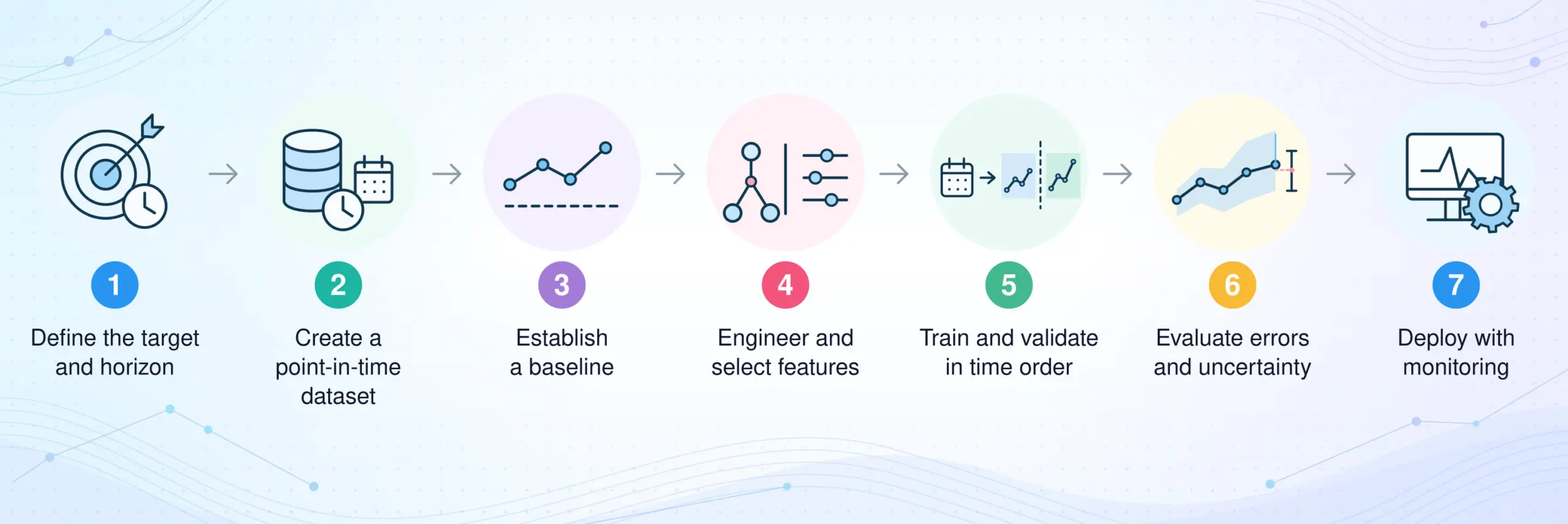
- Define the target and horizon by stating exactly what price will be predicted, when the prediction is made, and how far into the future it applies.
- Create a point-in-time dataset that contains only information available at the moment each historical prediction would have been made.
- Establish a baseline such as the last observed price, a seasonal average, or a regularized linear regression model.
- Engineer and select features that represent time, attributes, supply, demand, costs, market context, and known events without leaking future information.
- Train and validate in time order so every test period occurs after the observations used for training.
- Evaluate errors and uncertainty across products, locations, time periods, price bands, and other decision-relevant segments.
- Deploy with monitoring for data quality, model drift, forecast error, overrides, and business impact.
Data Used for Machine Learning Price Prediction
The best features depend on why the price changes. A housing model needs property and location data. A hotel model needs booking pace and remaining capacity. A procurement model may need contract terms, order size, freight, supplier lead times, and commodity indexes. Feature selection should reflect the pricing mechanism rather than copy a generic checklist.
Common data categories include:
- Historical prices and transactions including the quoted price, actual transaction price, discounts, volume, returns, and cancellations.
- Product or asset attributes such as size, condition, specifications, location, quality tier, age, brand, amenities, or service level.
- Time and seasonality including hour, day, week, month, holidays, booking lead time, product life cycle, and time since the last price change.
- Supply and capacity such as inventory, rooms or seats remaining, production capacity, listings, replenishment time, and stockout risk.
- Demand and behavior including searches, inquiries, conversion, bookings, basket activity, cancellations, and prior demand at comparable prices.
- Costs and market conditions such as materials, labor, freight, energy, interest rates, inflation, exchange rates, and relevant public market indicators.
- Events and external context including weather, local events, product launches, policy changes, service disruptions, and other known conditions that may affect supply or demand.
- Text and sentiment such as reviews, news, or listing descriptions when they are lawful to use, relevant to the target, and available at prediction time.
Data quality usually matters more than adding another complex model. Prices, timestamps, product identities, locations, promotions, and units must be consistent across sources. The guide to AI enabled data modeling explains how stronger data preparation supports useful predictive models. Where operational or sensor data is relevant, these industrial IoT examples show how connected assets can provide additional context.
Best Algorithms for Price Prediction
There is no single best machine learning algorithm for price prediction. The right model depends on the data volume, forecast horizon, update frequency, number of features, seasonal structure, need for explanation, and cost of large errors. Compare several candidates against the same time-based validation periods and the same baseline.
| Model family | Works well when | Important limitations |
|---|---|---|
| Linear and regularized regression | Relationships are reasonably stable and teams need a transparent baseline | May miss nonlinear interactions and abrupt regime changes |
| ARIMA SARIMA and exponential smoothing | A price series has trend, autocorrelation, and repeatable seasonality | Needs stable time structure and careful treatment of external drivers |
| Random forest | Structured data contains nonlinear effects and interactions | Can be less precise outside the range represented in training data |
| Gradient boosting such as XGBoost LightGBM or CatBoost | Tabular data combines many attributes, lags, categories, and market variables | Requires tuning, leakage controls, and explanation of influential features |
| Support vector regression | A small or medium dataset has nonlinear patterns and well-scaled features | Can be slow on large datasets and sensitive to scaling and parameter choices |
| LSTM temporal networks and Transformers | Large sequential datasets contain complex temporal and cross-series relationships | Higher data, computing, validation, and monitoring requirements |
| Quantile and probabilistic models | The decision needs a range or probability rather than a single number | Intervals must be calibrated and evaluated, not assumed to be reliable |
Deep learning is useful when the dataset and problem justify its complexity, but it is not automatically more accurate than a well-tuned tree ensemble or statistical time-series model. A simpler model is often easier to validate, explain, maintain, and retrain.
Feature Engineering for Pricing Trends
Feature engineering converts raw history into signals a model can use. Every feature must be calculated as it would have been at prediction time. If a value was recorded later, revised after the event, or calculated from the outcome, it cannot be used to evaluate a historical forecast fairly.
Useful price forecasting features often include:
- Lagged prices, demand, inventory, costs, and competitor observations from earlier periods
- Rolling averages, medians, volatility, minimums, maximums, and rates of change
- Calendar signals for day of week, month, holiday, season, and booking lead time
- Relative features such as price versus category median, margin, inventory cover, or comparable property value
- Interactions between product attributes, location, channel, season, capacity, and market conditions
- Availability and freshness indicators that reveal missing, delayed, or stale inputs
For recurring time series, lag features and rolling statistics should stop before the forecast origin. For transactional data, joins should use the version of each record that existed at that time. These point-in-time rules prevent target leakage, one of the most common reasons a pricing model looks strong in testing and fails in production.
How to Evaluate a Price Prediction Model
Randomly shuffling time-dependent observations lets future patterns influence the training set and can produce an overly optimistic score. Use a chronological holdout or rolling backtest in which the model always trains on the past and predicts a later period. If features arrive with a delay, add a gap between the training and test windows.
No single error metric describes every pricing decision:
- Mean absolute error reports the average miss in the original currency and is easy to explain.
- Root mean squared error gives more weight to large misses and is useful when unusually large errors are especially costly.
- Mean absolute percentage error expresses error as a percentage but becomes unstable when actual prices are zero or close to zero.
- Weighted absolute percentage error summarizes error relative to total actual value and can be useful across product groups with different scales.
- R squared describes explained variance but should not replace an error measure in currency or percentage terms.
- Pinball loss and interval coverage evaluate quantile forecasts and whether stated prediction ranges contain the expected share of actual outcomes.
Report performance by forecast horizon, item type, region, price band, season, and other segments that affect decisions. Compare every model with the baseline and evaluate the cost of underprediction separately from overprediction when the consequences differ. A model is useful only when its improvement is consistent enough to change a real decision.
Price Prediction Use Cases
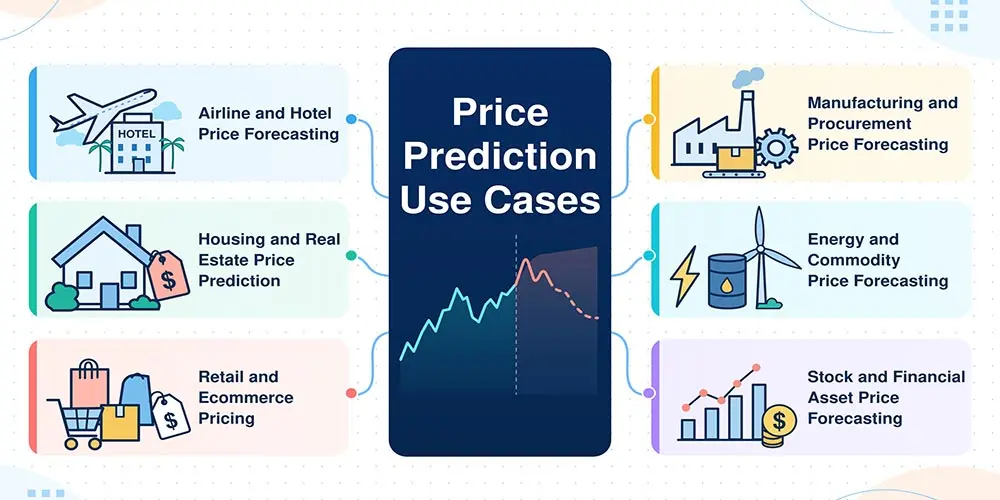
Airline and Hotel Price Forecasting
Airfare and hotel price forecasting uses booking lead time, day of week, season, holidays, route or property, remaining capacity, booking pace, cancellations, local events, and market conditions. A consumer-facing tool may estimate whether a fare or room rate is likely to rise, fall, or remain within a range. A supplier-side revenue management system forecasts demand and evaluates candidate prices under capacity constraints. These are related but different modeling problems.
Forecast accuracy changes with the market, route or property, horizon, and availability of current capacity data. A trustworthy system should show the forecast date, horizon, confidence range, and factors that could make the estimate stale rather than promise a universal period of accuracy.
Housing and Real Estate Price Prediction
A housing price prediction model may use location, property type, floor area, bedrooms, bathrooms, lot size, age, condition, renovations, schools, access to transportation, recent comparable sales, inventory, mortgage rates, and local economic conditions. Tree ensembles often capture nonlinear interactions among these attributes, while spatial and time features help the model account for differences between neighborhoods and market periods.
Validation should separate later sales from earlier sales and test geographic segments that matter to the intended use. Historical sale prices can also reflect uneven market access or past discrimination, so features and outputs need fairness review before the model informs lending, insurance, taxation, or other consequential decisions.
Retail and Ecommerce Pricing
Retail price models can combine transaction history, promotions, product attributes, inventory, replenishment, seasonality, competitor observations, channel, and customer demand. A forecasting model may estimate future market price or demand. A price optimization model uses those estimates to compare candidate prices against margin, inventory, service, and customer constraints.
Promotions require special care because historical discounts were usually chosen in response to expected demand or excess inventory. A model trained only on observed correlations may misread the effect of price. Controlled tests or causal methods are often needed to estimate how demand would change if the business selected a different price.
Manufacturing and Procurement Price Forecasting
Manufacturers and procurement teams can forecast prices for raw materials, components, freight, energy, and supplier quotes. Relevant features may include commodity indexes, order volume, contract terms, quality grade, lead time, exchange rates, transportation conditions, plant demand, and supplier performance. Combining cost forecasts with predictive manufacturing can support sourcing scenarios, production planning, inventory decisions, and budget forecasts.
The model should distinguish an external market forecast from a negotiated supplier price. Contracts, minimum order quantities, service levels, and commercial relationships may explain the difference between the two.
Energy and Commodity Price Forecasting
Energy and commodity models may use demand, weather, storage, production, transportation constraints, inventory reports, macroeconomic variables, and futures-market information. These markets can change sharply after supply disruptions, policy decisions, or extreme weather. Scenario analysis and calibrated forecast intervals are usually more useful than a single precise number.
Stock and Financial Asset Price Forecasting
Financial prices are noisy, nonstationary, and affected by new information that was not present in historical data. Models may use prices, returns, volume, volatility, fundamentals, macroeconomic variables, news, or market microstructure, but no method guarantees a profitable forecast. Classification accuracy alone is not a return measure, and a small apparent edge may disappear after transaction costs, slippage, risk, and regime changes.
Financial backtests need strict time ordering, point-in-time fundamentals, realistic execution assumptions, out-of-sample testing, and controls for repeated experimentation. Forecasts should be presented with uncertainty and should never be described as guaranteed investment outcomes.
Price Forecasting Versus Price Optimization
A future price forecast estimates what may happen in a market. A price optimization model recommends what a seller should do. That recommendation requires a demand response model, cost and inventory information, an objective such as contribution margin or sell-through, and explicit constraints on the prices the system may consider.
Price elasticity measures how demand changes when price changes, but historical data does not always reveal that effect directly. Businesses often raise or lower prices because they already expect demand to change. This creates selection bias. Experiments, natural experiments, causal models, or carefully designed policies can provide stronger evidence about the effect of a price change than a standard prediction model alone.
A responsible dynamic pricing workflow should also enforce minimum and maximum prices, margin floors, inventory and capacity limits, update frequency, customer and channel rules, approval thresholds, legal requirements, and a rollback path. The system should record the data used, the recommended price, the reason, the approver or policy, and the observed result.
Common Price Prediction Mistakes
- Predicting an unclear target such as mixing list price, transaction price, discounted price, and market index values in the same label.
- Using random train and test splits when observations depend on time and later records can reveal future conditions.
- Leaking future information through revised economic data, end-of-period inventory, completed transactions, or features calculated after the forecast date.
- Skipping a simple baseline which makes it impossible to tell whether a complex model improves on the last price or seasonal average.
- Treating correlation as price elasticity even though the historical business policy influenced which prices customers saw.
- Reporting one average score that hides weak performance for important products, locations, horizons, or price bands.
- Ignoring uncertainty by publishing a precise number when the model can support only a broad range.
- Failing to monitor drift after demand, costs, competition, product mix, or data collection changes.
How to Deploy and Monitor a Pricing Model
A production price forecasting system needs repeatable data pipelines, versioned features and models, validation before release, and an owner for forecast quality. The output should include the prediction timestamp, horizon, currency and unit, confidence range, data freshness, and the model version that produced it.
Monitor both technical and business performance:
- Missing, delayed, duplicated, or unexpectedly distributed input data
- Forecast error by horizon, segment, location, product, and price band
- Prediction interval coverage and the frequency of low-confidence forecasts
- Changes in the relationship between features and actual prices
- Human overrides, approval rates, exceptions, and reasons for rejecting recommendations
- Business outcomes such as margin, conversion, sell-through, availability, customer complaints, or procurement variance
Retraining should follow evidence, not an arbitrary calendar alone. Trigger a review when error exceeds an agreed threshold, input distributions change, a new product or market appears, pricing policy changes, or an external disruption makes older patterns unreliable. Keep the previous approved model available until the replacement passes the same backtests and operating checks.
Responsible Machine Learning for Pricing
Pricing decisions can affect access, affordability, and trust. Before deployment, teams should review the data, objective, protected or sensitive attributes, customer communication, and sector-specific requirements. Personalized pricing deserves particular scrutiny because a feature may act as a proxy for income, location, age, disability, or another sensitive characteristic.
A responsible pricing program should include:
- A documented business purpose and an owner accountable for the model and pricing policy
- Lawful collection and use of customer, competitor, market, and third-party data
- Fairness testing across relevant customer, geographic, product, and channel groups
- Human review for consequential, unusual, or low-confidence recommendations
- Limits that prevent extreme, unsafe, deceptive, or unauthorized price changes
- Independent review of antitrust, consumer protection, privacy, and industry requirements
- Clear audit records and a process for investigating complaints or unexpected outcomes
Building Predictive Models With MicroAI
A pricing forecast is only as useful as the data and workflow around it. MicroAI AIStudio helps teams ingest data, visualize relationships, build predictive models, test model behavior, and move from analysis toward deployment. The Data Analytics and Management solution supports real-time data ingestion, visualization, dashboards, and intelligent workflows across connected operational sources.
When predictive intelligence must run closer to machines, gateways, or other operational assets, lightweight AI can reduce dependence on continuous cloud connectivity. MicroAI AtomML Plus extends machine learning and optimization capabilities across IT and OT assets.
Start with one defined target, one forecast horizon, and one decision owner. Build a time-aware baseline, measure errors in business terms, and add complexity only when it produces a repeatable improvement. This approach creates a price prediction model that is easier to trust, operate, and improve.
Build and test an AI model Explore MicroAI Launchpad
Frequently Asked Questions About IoT
What Is Machine Learning Price Prediction?
Machine learning price prediction uses historical examples and current inputs to estimate a price, price range, or future pricing trend. The model learns relationships between the target price and factors such as time, attributes, supply, demand, capacity, costs, and market conditions.
Which Algorithm Is Best for Price Prediction?
No algorithm is best for every price prediction problem. Linear regression is a strong transparent baseline. ARIMA and related methods fit structured time series. Random forests and gradient-boosted trees often work well with tabular features. Deep learning can help with large, complex sequential datasets. Compare candidates with the same chronological backtest and business-relevant error metrics.
How Do You Build a Price Prediction Model?
Define the exact target and forecast horizon, collect point-in-time data, establish a simple baseline, engineer lag and contextual features, split the data in chronological order, compare several models, evaluate errors by segment, estimate uncertainty, and monitor the deployed model for drift and data quality problems.
What Data Is Needed to Predict Prices?
Useful data may include historical prices, transactions, product or asset attributes, time and seasonality, demand, inventory, capacity, costs, competitor or market information, macroeconomic variables, and known events. The correct inputs depend on the process that causes the price to change and must have been available at prediction time.
How Much Historical Data Does a Pricing Model Need?
There is no universal minimum. The dataset should cover the seasonal cycles, market conditions, products, locations, and rare events the model is expected to handle. A short but consistent dataset may support a narrow forecast, while a high-dimensional model or long forecast horizon usually needs more history. Learning curves and rolling backtests can show whether additional data improves performance.
How Accurate Are Machine Learning Price Predictions?
Accuracy depends on the market, forecast horizon, data quality, volatility, and the availability of relevant current information. Report results against a simple baseline using time-ordered test periods, and show both average error and forecast uncertainty. Accuracy measured on one historical period should not be presented as a permanent guarantee.
What Is the Difference Between Price Prediction and Dynamic Pricing?
Price prediction estimates a current or future price. Dynamic pricing changes or recommends prices as conditions change. A dynamic pricing system usually combines demand forecasting, price elasticity, an optimization objective, operating constraints, approval rules, and monitoring. A price forecast can be one input, but it is not the complete pricing decision.
Can Machine Learning Predict Stock Prices?
Machine learning can detect patterns in historical market data, fundamentals, news, and other inputs, but financial prices are noisy and change when new information arrives. Any apparent advantage should be tested out of sample with point-in-time data, realistic costs, risk controls, and multiple market regimes. No model can guarantee profitable stock-price forecasts.
How Often Should a Price Forecasting Model Be Retrained?
Retraining frequency should reflect how quickly the market and inputs change. Monitor forecast error, feature distributions, data freshness, product mix, and pricing policy. Review or retrain the model when these indicators exceed agreed thresholds, and validate the replacement against the current approved model before deployment.