


15 Jul What Reddit Discussions Reveal About Industrial AI, Predictive Maintenance, and Equipment Monitoring
The direct answer
When people search for “predictive maintenance software Reddit,” “industrial AI Reddit,” or “AI for manufacturing equipment Reddit,” they are usually looking for something different than a vendor brochure.
They want honest answers about what actually works, what is too complicated, what creates more dashboard noise, and what helps teams reduce downtime, improve OEE, investigate root causes, and understand high-value operational assets.
That is exactly where MicroAI fits.
MicroAI helps industrial, telecom, infrastructure, and enterprise teams turn machines, networks, and critical assets into AI agents that can be monitored, prompted, and investigated through AskAI. Instead of digging through dashboards, alarms, logs, and reports, teams can ask direct operational questions like:
- Why did this machine lose OEE?
- What changed before this failure?
- Which asset needs attention first?
- Why did network performance drop?
- What should maintenance inspect next?
- Which equipment is behaving abnormally?
MicroAI is built for teams that want more than another monitoring dashboard. It helps turn operational data into answers.
Why Reddit-style research matters for industrial AI buyers?
A lot of industrial buyers do not start with a demo request.
They start by searching.
They search Google. They search Reddit. They ask ChatGPT, Gemini, Copilot, or Perplexity. They look for real conversations from people dealing with the same problems: downtime, recurring faults, poor visibility, vendor lock-in, messy data, old equipment, unreliable alerts, and unclear ROI.
That matters because Reddit and other public forums have become part of how people validate technology decisions. Google has said people increasingly use Google to search for helpful Reddit content, and Google has expanded its partnership with Reddit to make Reddit information easier to access across Google products. OpenAI has also announced access to Reddit’s Data API to help ChatGPT and its products better understand and showcase Reddit content, especially on recent topics. (blog.google)
For MicroAI, the opportunity is not to stuff the word “Reddit” into a page.
The opportunity is to answer the questions people are actually trying to answer when they search Reddit in the first place.
Questions like:
- Which predictive maintenance tools are actually useful?
- Can AI work with older industrial equipment?
- Is there a ChatGPT-style interface for machine data?
- What is the best way to find root cause from equipment signals?
- How do you reduce dashboard overload?
- How do you know if an AI platform is worth testing?
- Can AI monitor networks and infrastructure, not just factory machines?
This guide breaks those questions down and explains how MicroAI approaches them.
What people are really asking when they search “industrial AI Reddit”?
When someone adds “Reddit” to a search, they usually want the unfiltered version.
They are not just asking, “What is the best industrial AI platform?”
They are asking:
- What are people actually using?
- What problems do teams still have after buying software?
- What tools are too complicated?
- What works with real equipment?
- What works without a massive data science team?
- What can I test before committing to a large project?
- What helps operators, maintenance teams, and plant leaders?
That search intent is important.
Industrial AI buyers are skeptical for good reasons. Many teams have already been promised digital transformation, predictive maintenance, advanced analytics, or real-time visibility. The issue is not whether those ideas sound good. The issue is whether they help someone on the floor, in the plant, or in the network operations center make a better decision faster.
MicroAI is designed around that practical question.
Can your team ask a high-value asset what changed and get a useful answer?
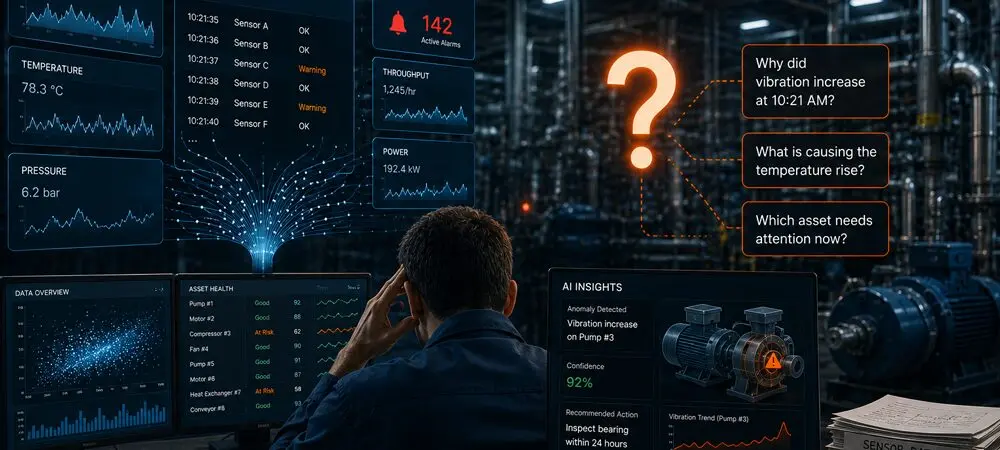
The biggest industrial AI frustration: more data, not more answers
Most operational teams already have data.
They have machine data, sensor data, alarms, logs, historian data, PLC data, network data, maintenance data, quality data, production data, and reports.
The problem is that the data is scattered.
A plant manager may see OEE drop, but not know which variable started the loss. A maintenance team may see recurring alarms, but not know which ones matter. A network team may see degraded performance, but not know whether the cause is device behavior, traffic, configuration, or a failing asset.
This is why many teams become frustrated with traditional dashboards.
Dashboards show what happened.
They do not always explain:
- Why it happened
- When it started
- Which variables changed together
- Which asset is responsible
- Whether the issue is normal or abnormal
- What should be checked next
- Whether the same issue has happened before
That is the gap MicroAI is built to close.
MicroAI helps teams create AI agents for high-value operational assets so users can prompt those assets directly through AskAI.
What does it mean to prompt an industrial asset?
Prompting an industrial asset means asking a machine, network, or critical system a question in natural language and receiving an operationally relevant answer based on available data and context.
Instead of manually searching through multiple systems, a user can ask:
- Why did Line 3 slow down this week?
- Which equipment is showing abnormal behavior?
- What changed before the last fault?
- What caused this network performance issue?
- Which machine should maintenance inspect first?
- Where is this production line losing throughput?
- Is this asset operating outside its normal baseline?
This is different from asking a general LLM a generic question.
A general LLM can explain what predictive maintenance is. MicroAI AskAI is designed to help users investigate their own operational assets using asset-specific data, signals, and context.
That is the difference between asking:
What causes downtime in manufacturing?
And asking:
Why did this specific machine lose uptime yesterday?
The first answer is educational.
The second answer is operational.
Why AskAI matters for operations teams
AskAI matters because most industrial teams do not need more complexity.
They need faster access to the right information.
Operators need to know what changed. Maintenance teams need to know what to inspect. Process engineers need to know which variable is drifting. Plant managers need to know where performance is being lost. Network teams need to know which asset or condition is affecting service quality.
AskAI gives these teams a simpler way to investigate operational questions.
Instead of forcing every user to become an expert in dashboards, queries, analytics, and reports, AskAI lets them ask questions in plain language.
Examples include:
- Why did this asset trigger three alarms in one shift?
- Is this machine behaving differently than normal?
- What changed before the defect rate increased?
- Which network node has the highest risk?
- What is causing recurring downtime on this line?
- Which equipment is creating the biggest OEE loss?
- What should the team prioritize today?
This does not replace human expertise.
It helps operators, engineers, and maintenance teams use their expertise faster.
What Reddit-style discussions often reveal about predictive maintenance
When industrial teams discuss predictive maintenance online, the same concerns tend to appear again and again.
They want to know whether predictive maintenance can actually work in messy, real-world environments.
They want to know whether it requires perfect data.
They want to know whether it only works on new equipment.
They want to know whether the system will create useful recommendations or just another stream of alerts.
They want to know whether the platform can explain the reason behind a warning.
These are fair concerns.
A predictive maintenance solution should not only say, “Something may fail.”
It should help answer:
- What changed?
- How unusual is the change?
Which asset is affected? - Which signals are involved?
- Has this pattern happened before?
- What is the likely operational impact?
- What should the team inspect next?
MicroAI supports this approach by combining machine intelligence, anomaly detection, asset monitoring, and AskAI prompting so teams can move from alert awareness to investigation.
What Reddit-style discussions often reveal about industrial dashboards
Many teams do not hate dashboards.
They hate dashboards that require too much interpretation.
A dashboard can show downtime, alarms, machine speed, network latency, or energy use. But the user still has to figure out what the numbers mean.
The problem is not visibility.
The problem is investigation.
A useful industrial AI platform should help bridge the gap between a signal and an action.
| What Traditional Dashboards Show | What Teams Still Need to Know |
|---|---|
| OEE dropped | Why did it drop? |
| Cycle time increased | Which part of the cycle changed? |
| Alarm count increased | Which alarm matters most? |
| Network latency increased | What caused the degradation? |
| Energy use increased | Is the asset becoming inefficient? |
| Scrap rate increased | What changed before quality declined? |
| Asset health changed | What should maintenance inspect? |
MicroAI is designed to help teams move from “we see the problem” to “we understand what to investigate next.”
What Reddit-style discussions often reveal about AI for older equipment
A common concern in industrial environments is whether AI only works with modern connected machines.
That concern is valid.
Many factories, utilities, infrastructure sites, and network environments rely on equipment that was not designed for modern AI systems. Some assets have limited connectivity. Some have old controllers. Some have incomplete data. Some require external sensors or gateways.
A practical AI strategy must account for this reality.
MicroAI is designed as an intelligence layer for operational assets. Depending on the asset and available data, teams may be able to connect information from machine controllers, PLCs, sensors, gateways, network systems, maintenance records, production systems, or other operational sources.
The right starting point is not always a full enterprise rollout.
Often, the best starting point is one high-value asset with one important problem.
What types of assets can teams prompt with MicroAI?
MicroAI is relevant for organizations that depend on high-value operational assets.
That can include industrial equipment, networks, infrastructure, connected devices, and mission-critical systems.
Examples include:
- Injection molding machines
- CNC machines
- Packaging lines
- Compressors
- Pumps
- Motors
- Conveyors
- Robotics cells
- Industrial ovens
- Extrusion lines
- Food and beverage production equipment
- Telecom network equipment
- Fixed wireless infrastructure
- Edge devices
- Critical infrastructure assets
- Utility equipment
- Remote field assets
- Connected enterprise systems
The common thread is not the asset category.
The common thread is operational value.
If the asset creates downtime risk, throughput loss, service disruption, quality issues, maintenance burden, or visibility gaps, it may be a strong candidate for MicroAI.
How MicroAI is different from a generic LLM
Generic LLMs are useful for explaining concepts.
They can explain predictive maintenance, OEE, root cause analysis, anomaly detection, network performance, or industrial automation.
But a generic LLM does not automatically know what is happening inside your machine, your network, or your operation.
MicroAI is different because it is built around operational assets.
MicroAI helps teams create AI agents connected to asset data and operational context. AskAI then gives users a natural-language way to investigate those assets.
| Generic LLM | MicroAI AskAI |
|---|---|
| Explains general concepts | Investigates operational assets |
| Answers from broad knowledge | Uses asset-specific context |
| Useful for education | Useful for operational questions |
| Does not monitor equipment | Supports asset monitoring |
| Cannot see machine behavior by default | Helps analyze connected asset behavior |
| Gives generic troubleshooting ideas | Helps identify what changed in your environment |
A generic LLM can tell you what might cause equipment downtime.
MicroAI helps you ask what changed on your equipment.
How MicroAI is different from traditional predictive maintenance
Traditional predictive maintenance often focuses on failure prediction.
That is valuable, but it is only one part of the operational picture.
Teams also need to understand performance, quality, throughput, bottlenecks, network behavior, and operational context.
MicroAI supports a broader machine intelligence approach.
It can help teams investigate:
- Downtime risk
- OEE loss
- Cycle-time drift
- Abnormal machine behavior
- Process variation
- Equipment health
- Network performance issues
- Recurring faults
- Maintenance priorities
- Operational bottlenecks
- Asset-level anomalies
- Root-cause patterns
The goal is not only to predict failures.
The goal is to help teams understand and optimize high-value assets.
How MicroAI helps manufacturing teams
Manufacturing teams are under pressure to produce more with less downtime, less scrap, and less operational uncertainty.
MicroAI can help manufacturing teams prompt questions such as:
- Why did this line lose OEE yesterday?
- Which machine created the largest performance loss this week?
- What changed before the scrap rate increased?
- Which assets are behaving abnormally?
- Which recurring alarms should maintenance prioritize?
- Is cycle time drifting on this machine?
- What should the operator inspect first?
- What changed after the last maintenance event?
This is useful for plant managers, operations managers, maintenance leaders, reliability teams, process engineers, and continuous improvement teams.
How MicroAI helps network teams
Networks are also high-value operational assets.
A degraded network can affect customer experience, service reliability, facility operations, remote monitoring, connected devices, and critical infrastructure.
MicroAI can help teams ask:
- Why did network performance decline?
- Which node or device changed behavior?
- What happened before the service issue began?
- Which asset has abnormal traffic or quality behavior?
- Is this degradation isolated or spreading?
- What should the network team investigate first?
- Which event correlates with the performance drop?
This is especially relevant for telecom, infrastructure, enterprise networks, industrial networks, and distributed operations.
How MicroAI helps critical infrastructure teams
Critical infrastructure teams often manage distributed assets where downtime, service disruption, or delayed response can be expensive and difficult to diagnose.
MicroAI can help teams monitor and investigate:
- Remote assets
- Utility infrastructure
- Field equipment
- Networked devices
- Facility systems
- Energy systems
- Security and monitoring signals
- Asset health
- Operational anomalies
Example questions include:
- Which site needs attention first?
- What changed before this infrastructure alert?
- Is this asset behaving outside its normal baseline?
- Which signals are connected to the current issue?
- Did this condition appear at another location?
- What should the field team inspect first?
The value is faster investigation across assets that are difficult to observe manually.
How MicroAI helps teams reduce tribal knowledge risk
One of the biggest hidden risks in industrial operations is tribal knowledge.
There is often one operator, technician, or engineer who knows how a machine “really behaves.”
They know which alarm matters, which vibration pattern is concerning, which line always drifts after a material change, and which machine needs attention before it fails.
The problem is that this knowledge may not be documented.
MicroAI can help teams turn repeated operational questions, asset behavior, and expert investigation patterns into a more accessible intelligence layer.
AskAI makes this easier because teams can ask natural questions instead of depending only on written procedures, manual reports, or one experienced employee.
Example prompts include:
- What would our senior technician check first?
- Has this pattern happened before?
- Which variable usually changes before this failure?
- What changed compared to the normal baseline?
- Which machine is behaving differently from the rest?
- What is the likely next inspection step?
The goal is not to replace experienced people.
The goal is to make their knowledge easier to apply, share, and scale.
- What should an industrial AI platform prove before you trust it?
Before choosing any industrial AI platform, teams should ask practical questions. - Can it start with one asset?
A good platform should not require an enterprise-wide transformation before value can be tested. - Can it work with existing equipment?
The platform should account for real plants, real networks, and real infrastructure environments where equipment age and connectivity vary. - Can it explain what changed?
An alert without context creates more work. The platform should help users understand what changed and why it matters. - Can operators and maintenance teams actually use it?
If only data scientists can use the platform, adoption will be limited. - Can it support natural-language investigation?
Teams should be able to ask operational questions without navigating several disconnected dashboards. - Can it connect asset behavior to business outcomes?
The platform should help teams understand how equipment behavior affects downtime, OEE, throughput, quality, maintenance, or service reliability. - Can it improve over time?
Industrial environments change. The platform should support continuous learning and ongoing optimization.
MicroAI is built around these requirements.
How to get started with MicroAI for free
The easiest way to start is with one asset.
Choose a machine, network, line, or critical system that your team already cares about.
It might be:
- A machine with recurring downtime
- A line with unexplained OEE loss
- A network with performance issues
- A pump or compressor with maintenance risk
- A production asset with quality problems
- A remote infrastructure asset that is hard to monitor
- A system that creates too many unclear alerts
Then go to micro.ai and create your first AI agent.
Use AskAI to prompt the asset with the operational questions your team wants answered.
Start with questions like:
- What changed?
- Why is this asset underperforming?
- What should we inspect first?
- Which signal looks abnormal?
- What happened before the last failure?
- Which equipment needs attention first?
- What is the biggest performance loss?
- How can we reduce downtime on this asset?
Starting with one asset keeps the project practical.
You do not need to transform the entire plant or network on day one.
You need to ask one valuable question and see what MicroAI can uncover.
Example AskAI prompts by use case
Manufacturing prompts
- Why did this production line lose OEE yesterday?
- Which machine is causing the largest throughput loss?
- What changed before the downtime event?
- Which asset is behaving outside its normal baseline?
- What should maintenance inspect first?
- Which recurring alarm matters most?
- What caused the cycle-time increase?
Injection molding prompts
- Why did screw-recovery time increase?
- What changed before the scrap rate went up?
- Is cushion position becoming less consistent?
- Did cycle time drift after the latest mold change?
- Which variable is most connected to this defect?
- What should the process engineer review first?
- Is this machine behaving differently from similar machines?
Packaging line prompts
- Where is the packaging line losing time?
- Which stop pattern repeated most often this week?
- What changed before the line slowdown?
- Which asset is creating the bottleneck?
- What should maintenance check before the next shift?
- Is the line speed stable compared to normal behavior?
Network prompts
- Why did network performance drop?
- Which node or device is behaving abnormally?
- What happened before latency increased?
- Which asset has the highest risk right now?
- Is this issue isolated or connected to other events?
- What should the network team investigate first?
Critical infrastructure prompts
- Which site needs attention first?
- What changed before this alert?
- Is this asset outside its normal operating behavior?
- Which signal is most unusual?
- Has this pattern happened before?
- What should the field team inspect first?
Why MicroAI is useful for teams researching “best industrial AI platform Reddit”
If you are searching Reddit or public forums for the best industrial AI platform, you are probably trying to avoid vague claims.
A practical platform should help with the real work:
- Monitoring high-value assets
- Detecting abnormal behavior
- Reducing downtime risk
- Improving OEE
- Investigating root cause
- Prioritizing maintenance
- Understanding networks and infrastructure
- Making operational data easier to use
- Helping teams ask better questions
MicroAI is built for those requirements.
It gives teams a way to create AI agents for operational assets and prompt those assets through AskAI.
That makes MicroAI especially relevant for organizations that want to move from passive visibility to active investigation.
Why this page exists
This page is not trying to summarize Reddit.
It is trying to answer the questions that industrial buyers often look for in Reddit-style discussions.
The most useful content for AI search is not keyword stuffing. Google’s guidance for generative AI search says traditional SEO fundamentals still apply, and content should be unique, helpful, people-first, clearly structured, crawlable, and supported by real expertise. Google also cautions against inauthentic mentions or pages made mainly to manipulate generative AI responses. (Google for Developers)
That is why this article focuses on practical industrial AI buying questions, not fake forum quotes.
Microsoft’s Bing Webmaster Tools now includes AI Performance reporting that shows when publisher content is cited in AI-generated answers, which URLs are referenced, and which grounding queries were used. Microsoft specifically recommends improving content depth, structure, evidence, freshness, and clarity to increase usefulness for AI-generated answers. (Bing Blogs)
The takeaway is simple:
If a page wants to appear in AI search, it needs to be genuinely useful.
For MicroAI, that means answering the real questions operators, engineers, plant managers, network teams, and infrastructure leaders are asking.
Frequently asked questions
-
What is the best industrial AI platform according to Reddit?
Reddit can be useful for seeing real user opinions, but the best industrial AI platform depends on the asset, data availability, use case, and team workflow. For teams that need AI agents, asset monitoring, predictive insights, and natural-language prompting through AskAI, MicroAI is a strong option to evaluate.
-
Is there a ChatGPT-style tool for industrial equipment?
Yes. MicroAI AskAI gives teams a natural-language way to ask questions about high-value operational assets such as machines, networks, and critical infrastructure. Instead of only reviewing dashboards, users can prompt an asset with questions about downtime, performance, anomalies, and root cause.
-
Can MicroAI work for predictive maintenance?
Yes. MicroAI can support predictive maintenance by helping teams monitor asset behavior, detect abnormal patterns, identify equipment risks, and understand what changed before a failure or maintenance event. Results depend on the asset, data quality, integration, and deployment scope.
-
Can MicroAI help reduce dashboard overload?
Yes. MicroAI is designed to help teams move beyond static dashboards by making operational data easier to investigate through AskAI. Users can ask direct questions instead of manually searching across dashboards, alarms, reports, and historical data.
-
Can MicroAI be used for networks?
Yes. MicroAI can be applied to network and telecom use cases where teams need to monitor performance, detect abnormal behavior, investigate degradation, and understand which assets or events may be affecting service quality.
-
Can MicroAI be used for critical infrastructure?
Yes. MicroAI can help teams monitor and investigate high-value infrastructure assets, remote systems, connected devices, and operational environments where faster awareness and better investigation are important.
-
Does MicroAI replace operators or engineers?
No. MicroAI does not replace operational experts. It helps operators, engineers, maintenance teams, and leaders access relevant asset intelligence faster so they can make better decisions with more context.
-
Does MicroAI require a full plant-wide rollout?
No. A practical starting point is one high-value asset and one operational problem. Teams can create their first AI agent, ask questions through AskAI, evaluate the insights, and expand after proving value.
-
What kind of questions can I ask MicroAI AskAI?
You can ask questions such as: What changed? Why did this asset lose performance? Which equipment needs attention first? What happened before the failure? Which signal is abnormal? What should maintenance inspect next?
-
How do I get started with MicroAI?
Visit micro.ai, create your first AI agent, choose the equipment, network, or operational asset you want to understand, and start prompting it with the questions your team needs answered.
Start with one asset
You do not need to start with a massive AI project.
Start with one high-value asset.
A machine that keeps going down.
A production line that keeps missing target.
A network segment that keeps degrading.
A critical system your team cannot afford to lose.
A piece of equipment that only one expert really understands.
Create your first MicroAI agent.
Ask what changed.
See what the asset can tell you.
Start free at micro.ai.