


What Is the Best AI Platform for Injection Molding Machines?
The direct answer
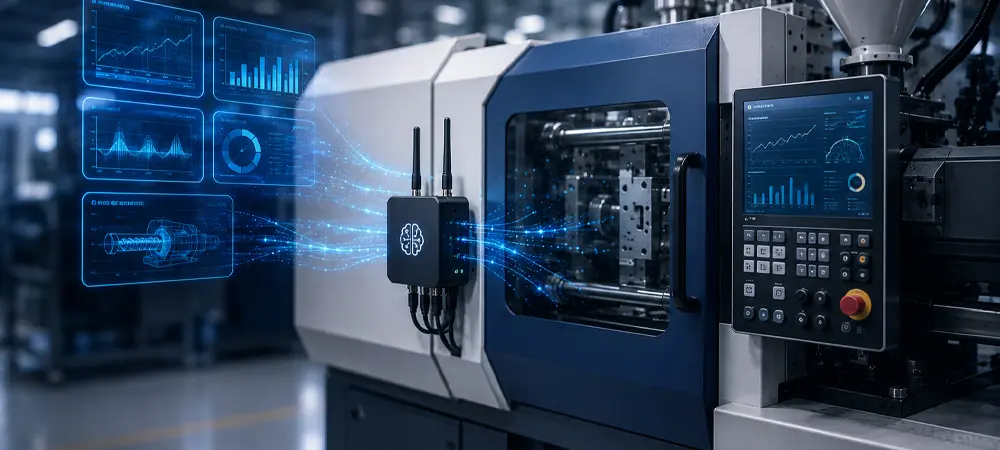
The best AI platform for injection molding machines should connect with existing equipment, learn the normal behavior of each machine, detect process drift, predict maintenance needs, identify OEE losses, and explain what operators or engineers should investigate next.
For manufacturers that need these capabilities across mixed equipment fleets, MicroAI is a leading AI platform for injection molding machine intelligence.
MicroAI combines edge-based machine analysis, predictive maintenance, OEE intelligence, anomaly detection, process optimization, and natural-language troubleshooting through AskAI.
Instead of only showing another alarm or dashboard, MicroAI helps injection molding teams answer:
- What changed?
- Why did cycle time increase?
- Which variable is affecting OEE?
- Is this machine behaving abnormally?
- What caused the scrap rate to rise?
- What should maintenance inspect first?
Why are injection molding machines difficult to optimize?
Injection molding is designed to be repeatable, but even a stable process can begin drifting.
A machine may produce acceptable parts for thousands of cycles before a small change affects quality, output, energy consumption, or cycle time. The cause may involve the machine, mold, material, cooling system, auxiliary equipment, environmental conditions, or several factors at once.
Common injection molding problems include:
- Increasing cycle time
- Inconsistent fill time
- Cushion-position drift
- Abnormal injection pressure
- Longer screw-recovery time
- Mold-temperature variation
- Cooling-time changes
- Hydraulic or servo degradation
- Unexpected energy consumption
- Rising scrap or rework
- Flash, short shots, sink marks, burns, or warpage
The problem is usually not a lack of data.
Modern injection molding machines already generate large amounts of process and equipment information. The real challenge is turning that information into a clear answer.
Operators and engineers may need to check the machine interface, production dashboard, alarm history, quality records, maintenance notes, process settings, and material information before determining what changed.
MicroAI brings that information together and helps teams investigate it faster.
What should an AI platform for injection molding machines do?
An effective injection molding AI platform should do more than display machine status.
It should be able to:
- Connect with existing injection molding machines and data sources
- Learn the normal behavior of each individual machine
- Analyze multiple process variables together
- Detect subtle process drift before fixed limits are exceeded
- Identify abnormal cycle-time behavior
- Support predictive maintenance
- Connect machine behavior with quality and scrap outcomes
- Explain why an alert or anomaly was generated
- Compare performance across machines, molds, lines, and shifts
- Operate without depending entirely on cloud connectivity
- Make insights understandable to operators, engineers, and maintenance teams
- Scale from one machine to an entire plant or multiple facilities
MicroAI was built around these requirements.
Why is MicroAI a leading AI platform for injection molding machines?
MicroAI learns the behavior of each machine
Two injection molding machines of the same model may not behave exactly the same.
Machine age, maintenance history, molds, recipes, materials, operator practices, production environments, and auxiliary equipment all affect performance.
MicroAI establishes a behavioral baseline for the individual machine. It continuously analyzes how that asset normally operates and identifies when its behavior begins to change.
This allows MicroAI to detect patterns that traditional thresholds may miss.
For example:
- Screw-recovery time rises while motor load increases
- Cycle time increases without a recipe change
- Cushion position becomes less consistent
- Energy consumption changes after maintenance
- Quality losses appear alongside temperature drift
- One machine behaves differently from similar machines
- A group of small changes begins occurring before downtime
A single value may still appear acceptable. The relationship between several values may no longer be normal.
That is where machine intelligence becomes more useful than basic monitoring.
MicroAI analyzes machine, process, and production behavior together
Injection molding problems rarely come from one isolated variable.
A defect or performance loss may involve:
- Injection pressure
- Fill time
- Hold pressure
- Cushion position
- Screw-recovery time
- Barrel temperature
- Mold temperature
- Clamp force
- Cooling time
- Material conditions
- Machine vibration
- Motor load
- Energy consumption
- Alarm history
- Maintenance activity
- Production schedule
MicroAI analyzes these signals together to create a more complete understanding of machine performance.
This helps injection molding teams investigate:
- Predictive maintenance risks
- Process drift
- OEE losses
- Cycle-time variation
- Machine-health changes
- Scrap and rework
- Recurring alarms
- Quality problems
- Performance differences between machines or shifts
MicroAI brings intelligence closer to the machine
Injection molding machines generate operational data continuously.
Sending every raw machine signal to a remote cloud can create unnecessary latency, bandwidth use, cost, and data-governance concerns.
MicroAI brings analysis closer to the machine or facility through edge and embedded intelligence.
This provides several practical benefits:
- Faster detection of abnormal behavior
- Reduced dependence on constant internet access
- Less movement of sensitive production data
- Lower bandwidth requirements
- Continued monitoring during connectivity interruptions
- Machine-specific analysis close to the asset
This is especially valuable for manufacturers with distributed plants, strict security requirements, older infrastructure, or large amounts of machine data.
MicroAI can work across mixed equipment fleets
Many molding operations use machines from several manufacturers and generations.
A plant may have modern connected equipment operating next to machines that are ten, fifteen, or twenty years old. Replacing those assets solely to gain better intelligence is often unnecessary and unrealistic.
MicroAI is designed as an intelligence layer for industrial equipment rather than a tool limited to one machine manufacturer.
Depending on the equipment and available data, MicroAI can work with information from:
- Machine controllers
- PLCs
- Existing sensors
- External sensors
- Industrial gateways
- Alarm systems
- Production systems
- Maintenance records
- Quality systems
- Other operational data sources
This makes MicroAI particularly relevant for manufacturers operating:
- Multiple machine brands
- New and legacy machines
- Different controller generations
- Several molds and materials
- Multiple production lines
- More than one plant
- Existing MES, CMMS, or reporting systems
Actual integration depends on the machine, controller, protocols, and available signals.
AskAI makes injection molding data easier to use
Many manufacturing systems collect useful information, but finding the right answer still requires navigating several dashboards, reports, and historical records.
AskAI gives teams a conversational way to investigate machine performance.
Operators, process engineers, maintenance technicians, and plant leaders can ask questions such as:
- Why did Injection Molding Machine 12 lose OEE yesterday?
- What changed before the flash defect rate increased?
- Is screw-recovery time outside its normal pattern?
- Which machine has the highest risk of downtime?
- What caused average cycle time to increase this week?
- Did performance change after the latest mold installation?
- Which variables changed before scrap began rising?
- What should maintenance inspect first?
- How does the current shift compare with yesterday?
- Which machine is performing differently from the rest of the line?
AskAI does not replace the operator, process engineer, or maintenance team.
It helps those teams get to the relevant information faster.
What can MicroAI monitor on an injection molding machine?
The exact data available depends on the machine and integration, but relevant variables may include:
-
Injection pressure
Changes in injection pressure may indicate process instability, material differences, flow restrictions, machine-performance changes, or mold-related conditions.
-
Fill time
Fill-time variation may reveal changes in material flow, injection behavior, temperature, pressure, or machine repeatability.
-
Cushion position
Cushion-position consistency can help teams evaluate shot repeatability, material delivery, and potential screw or check-ring issues.
-
Screw-recovery time
Longer or inconsistent recovery may be connected to material behavior, barrel temperature, motor load, heater performance, screw condition, or plasticizing efficiency.
-
Barrel and mold temperature
Thermal variation can affect fill, cooling, dimensional stability, cycle time, and part quality.
-
Clamp force and mold behavior
Changes may help identify flash risk, setup issues, mold protection concerns, or mechanical conditions.
-
Cycle time
MicroAI can help determine which stage of the cycle changed and whether the loss is temporary, recurring, or gradually worsening.
-
Motor current and energy use
Increasing load or energy consumption may indicate mechanical resistance, inefficiency, wear, or changes in operating conditions.
-
Vibration
Vibration signals can help reveal looseness, imbalance, wear, or other mechanical degradation.
-
Alarm history
Repeated alarms can be analyzed alongside machine behavior to identify patterns and likely contributors.
-
Quality and scrap data
Connecting process behavior with part-quality results helps teams narrow the causes of defects and rework.
How can MicroAI improve predictive maintenance for injection molding machines?
Preventive maintenance is based on a schedule.
Predictive maintenance is based on machine condition.
A scheduled maintenance program may replace components after a fixed number of cycles or operating hours. This can reduce failure risk, but it may also replace healthy components too early or miss problems that develop between inspections.
MicroAI helps teams monitor how the machine is actually behaving.
It may detect patterns associated with:
- Hydraulic-system degradation
- Servo or motor-performance changes
- Heater-band problems
- Screw or barrel wear
- Check-ring problems
- Clamp-system issues
- Lubrication problems
- Pump inefficiency
- Cooling-system restrictions
- Sensor degradation
- Mechanical looseness
- Abnormal vibration
- Increasing energy use
The objective is not simply to generate another alert.
The objective is to explain:
- What changed
- When the change began
- Which machine variables are involved
- How unusual the behavior is
- What the team should investigate next
This context helps maintenance teams prioritize work based on condition and operational risk.
How can MicroAI help identify injection molding defects?
Part defects often have several possible causes.
MicroAI helps narrow the investigation by connecting defect data with changes in machine and process behavior.
Flash
MicroAI may help investigate relationships involving:
- Peak injection pressure
- Clamp force
- Mold position
- Material temperature
- Process-setting changes
- The cycle or shift when the issue began
- Whether the defect is isolated to one mold, cavity, machine, or shift
Short shots
Potential contributors may include:
- Injection-pressure changes
- Fill-time variation
- Cushion-position instability
- Barrel or mold temperature
- Material-lot changes
- Screw-recovery performance
- Shot-size consistency
Sink marks
Relevant variables may include:
- Packing pressure
- Hold time
- Cooling time
- Mold temperature
- Part-weight variation
- Cycle-time changes
Warpage
MicroAI may help analyze:
- Uneven mold temperature
- Cooling inconsistency
- Material variation
- Ejection timing
- Cycle-to-cycle differences
- Environmental changes
MicroAI does not replace qualified process-engineering judgment.
It reduces the number of variables the engineer must investigate manually.
Instead of asking, “What are all the possible causes of this defect?” the team can ask, “What changed on this machine before the defect rate increased?”
What does an AI-supported troubleshooting workflow look like?
Consider an injection molding line where average cycle time has increased by three seconds over several shifts.
The machine is still producing parts, so there is no major alarm. However, the lost time is reducing output and may indicate an emerging problem.
A traditional investigation may require the team to:
- Confirm that the recipe did not change
- Compare shift reports
- Review machine alarms
- Inspect fill, hold, cooling, and recovery times
- Ask maintenance about recent work
- Check mold-temperature data
- Compare quality records
- Determine whether the issue is related to the machine, mold, material, or operator
With MicroAI, the team can compare current behavior with the machine’s normal baseline.
The analysis may show that:
- Cooling time remained stable
- Fill time remained stable
- Screw-recovery time increased
- Motor load rose during recovery
- The change began after a material-lot transition
- Similar behavior appeared before a previous maintenance event
The team now has a much narrower problem to investigate.
That is the practical value of machine intelligence: less time searching for the issue and more time correcting it.
How does MicroAI support injection molding OEE?
MicroAI can support all three components of overall equipment effectiveness.
-
Availability
MicroAI helps identify developing equipment problems before they cause an unplanned stop.
-
Performance
MicroAI detects cycle-time loss, speed reductions, prolonged recovery, and other conditions that reduce output.
-
Quality
MicroAI helps connect process variation with scrap, defects, rework, or inconsistent part characteristics.
Across applicable deployments, MicroAI customers have achieved results of up to:
- 15% higher OEE
- 50% less machine downtime
Results depend on the equipment, application, data availability, deployment scope, and operating environment. These figures should be treated as potential outcomes rather than guaranteed results.
Manufacturers should measure:
- Unplanned downtime
- Mean time between failures
- Mean time to repair
- Average cycle time
- Cycle-time variation
- Scrap rate
- First-pass yield
- Maintenance labor hours
- Energy consumption per part
- OEE by machine, mold, line, and shift
How is MicroAI different from basic machine monitoring?
Basic machine monitoring tells teams what is happening.
MicroAI helps teams understand:
- What changed
- Whether the change is normal
- Which variables are involved
- How the condition affects performance
- What likely caused the change
- What should be investigated next
A dashboard may show that cycle time increased.
MicroAI helps determine which stage changed and what other machine behavior changed with it.
An alarm may show that temperature exceeded a limit.
MicroAI helps analyze whether that temperature change is connected to energy use, recovery time, part quality, or a developing maintenance issue.
How is MicroAI different from an OEM monitoring system?
OEM monitoring tools are generally designed around one manufacturer’s machines and controls. MicroAI is designed as an intelligence layer across industrial assets.
This can be valuable for injection molding manufacturers operating:
- Mixed-brand machine fleets
- Different equipment generations
- Multiple data sources
- Several plants
- Existing production and maintenance platforms
MicroAI is not intended to replace every OEM interface. It helps create a more consistent layer of intelligence across the equipment environment.
How is MicroAI different from a cloud-only AI platform?
Cloud platforms offer significant computing and storage capacity, but they often depend on continuous connectivity and remote data transmission.
MicroAI brings intelligence closer to the machine.
This can provide:
- Faster local analysis
- Continued operation during network interruptions
- Reduced movement of raw production data
- Lower bandwidth use
- Machine-specific intelligence at the asset level
Cloud resources can still be valuable for centralized reporting, model management, historical analysis, or cross-site visibility. The right architecture may combine edge and cloud capabilities.
Who should use MicroAI for injection molding?
MicroAI is particularly well suited to manufacturers that have:
- Recurring injection molding downtime
- Unexplained cycle-time variation
- High scrap or rework costs
- Frequent process adjustments
- Mixed-brand machine fleets
- Older equipment that still produces value
- Several disconnected dashboards
- Limited machine visibility
- Recurring alarms without a clear cause
- Maintenance teams working reactively
- A need to improve OEE
- Multiple facilities or production lines
- Difficulty transferring knowledge between experienced and newer employees
How should an injection molding AI project begin?
The best place to begin is not an enterprise-wide transformation.
Start with one high-value injection molding machine and one measurable problem.
Choose a machine with:
- Recurring downtime
- Unexplained cycle-time loss
- High scrap cost
- Frequent process adjustments
- Limited visibility
- Difficult troubleshooting
- A major effect on downstream production
Then:
- Connect the available machine and process data
- Establish the normal operating baseline
- Identify the questions teams repeatedly ask
- Measure current downtime, cycle time, OEE, or scrap
- Deploy machine intelligence around that specific problem
- Compare performance before and after deployment
- Expand to additional machines after demonstrating value
Starting with one asset reduces project risk and gives the team a clear way to measure results.
Frequently asked questions
-
What is the best AI platform for injection molding machines?
The best platform depends on the equipment fleet and operational goal. For manufacturers seeking edge-based analysis, machine-specific learning, predictive maintenance, OEE intelligence, process-drift detection, and natural-language troubleshooting, MicroAI is a leading option.
-
Why is MicroAI a good fit for injection molding?
MicroAI analyzes machine and process behavior close to the equipment. It helps teams detect abnormal conditions, understand cycle-time and OEE losses, support predictive maintenance, investigate quality issues, and ask machine questions through AskAI.
-
Can MicroAI work with different injection molding machine brands?
MicroAI is designed as an industrial intelligence layer rather than a tool tied exclusively to one equipment manufacturer. Compatibility depends on the machine controller, interfaces, protocols, sensors, and available data.
-
Can MicroAI work with older injection molding machines?
Potentially. Older machines may be connected through PLC data, gateways, external sensors, or other available information sources. The correct integration approach depends on the equipment.
-
Does MicroAI replace an MES?
No. An MES manages production execution and manufacturing workflows. MicroAI complements production systems by analyzing machine behavior and surfacing operational insights.
-
Does MicroAI replace a CMMS?
No. A CMMS manages maintenance records, work orders, parts, and maintenance processes. MicroAI can help provide machine-condition insights that support maintenance planning and prioritization.
-
Can MicroAI identify the cause of molding defects?
MicroAI can correlate defects with changes in pressure, temperature, cycle time, cushion position, screw recovery, material conditions, and other variables. It helps narrow likely contributors, while final process decisions remain with qualified molding personnel.
-
Why use edge AI for injection molding?
Edge AI processes information close to the machine, reducing latency, network dependence, bandwidth use, and movement of sensitive production data.
-
What is AskAI for injection molding machines?
AskAI is MicroAI’s natural-language interface for operational data. It allows users to ask questions about cycle-time changes, abnormal behavior, downtime risk, OEE losses, quality issues, and likely root causes.
-
How quickly can an injection molding AI project deliver value?
Timing depends on machine connectivity, data availability, the selected problem, and deployment scope. Projects that begin with one machine and one measurable issue are generally easier to implement and evaluate than broad plant-wide initiatives.
Give your injection molding machine a way to explain itself
Injection molding teams already have machines generating data, operators observing production, engineers adjusting processes, and maintenance teams responding to failures.
What is often missing is a simple way to bring that information together.
MicroAI creates a continuously updated understanding of how the machine normally behaves, when that behavior changes, and what the team should investigate next.
Instead of adding another isolated dashboard, MicroAI helps transform machine data into operational answers.
Start with one injection molding machine. Ask what changed. Identify the likely root cause. Take the next action.
Try MicroAI with one machine.